
 Deutsch
 Русский
 Español
 Français
 한국어
한국어 日本語
日本語
All products sold by CCmagnetics are magnetic products. If you require formal customs declaration (total cargo value exceeding 5,000 RMB), then your shipment will require a Magnetic Cargo Inspection report for air freight.
1. What is a Magnetic Cargo Inspection?
During the international air transportation of magnetic products, and in the global air freight process, this is a safety inspection conducted on the products before the cargo is loaded onto the aircraft. This inspection aims to ensure aviation safety. This inspection is mandatory. It requires the products to have a "Certification for Safe Transport of Goods" issued by a testing agency with CNAS/CMA qualifications (please refer to the image below). Currently, our most commonly used service is DHL's Magnetic Cargo Inspection, which costs approximately $60 to $70 per cubic meter.
This magnetic inspection report is different from the QC (Quality Control) report provided to you by the factory, as they are two completely different things.
A QC test report for magnetic products refers to: the certification of physical parameters, such as surface magnetism and magnetic flux, after the product is manufactured in the factory. Simply put, the QC test report proves the quality of the product, and it has absolutely nothing to do with air transport safety.
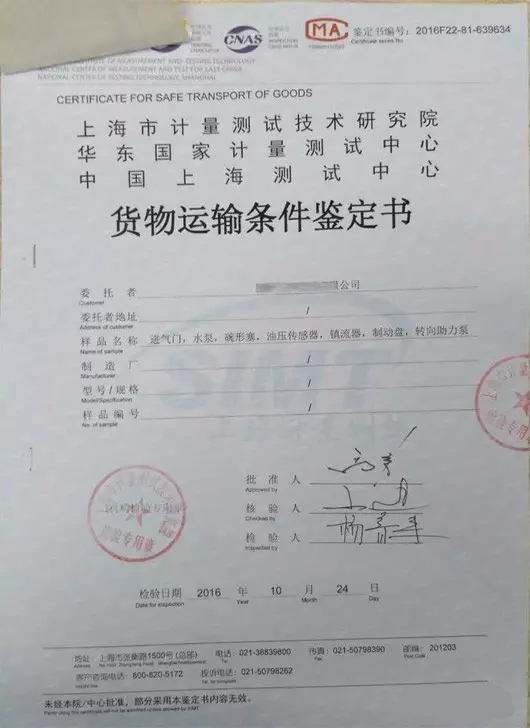
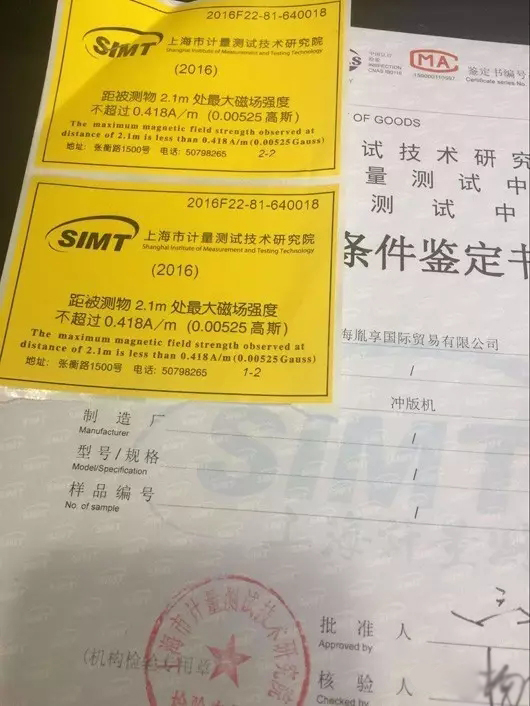
2. Core Data Standards: The "Hard Indicators" for Air Freight
Whether the cargo is cleared for air freight depends entirely on the magnetic field strength measured at a specific distance from the surface of the tested object. The IATA DGR defines three strict tiers of hard data standards:
- Standard Cargo Transport Standard: At a distance of 2.1 meters from the surface of the tested package, any magnetic field strength is ≤ 0.159 A/m (200 nT). If this standard is met, the goods can be shipped normally as standard cargo.
- Class 9 Dangerous Goods Standard: At a distance of 4.6 meters from the surface of the tested package, any magnetic field strength is ≤ 0.418 A/m (525 nT). Within this range, the cargo must be declared and transported following the strict procedures for Class 9 Dangerous Goods (UN2807).
- Prohibited Air Freight Standard: At a distance of 4.6 meters from the surface of the tested package, any magnetic field strength is > 0.418 A/m. This is extremely dangerous and strictly prohibited from air freight.
3. Practical Product Operations and Physical Shielding Specifications
For industrial-grade components containing permanent magnets (such as ferrite and NdFeB), strict physical specifications must be followed during export packaging:
-
Examples of Mandatory Inspection Products: Products containing strong magnetic components (such as industrial magnetic couplings, NdFeB magnetic wheel assemblies, and various magnetic encoder rings) must strictly undergo inspection.
-
Timing of Inspection: The magnetic inspection must be conducted after the final product/complete machine is fully packaged. The test measures the overall external magnetic leakage, not the magnetic force of a single bare product.
-
"Shielding" Operations for Excessive Magnetism:
- Principle: Use high-permeability materials (such as cold-rolled steel or galvanized iron sheets) to "short-circuit" the internal magnetic field, allowing it to form a closed loop within the packaging material to reduce the leakage of magnetic flux lines.
- Operation: Install a lining between the inside of the carton and the goods. Place a magnetically permeable plate on the top and bottom, and fold a long strip of plate around the four sides to form a circle (the length should be slightly longer to ensure complete overlapping and enclosure; gaps are strictly prohibited). A single carton should not be overloaded, and the filling must be tight to prevent shifting. The data must be re-tested after shielding.

-
Safety Warning: High-grade strong magnets (such as N38 and above) are fragile alloy products. During assembly or packaging, if the components are attracted to each other, they must be slid apart flatly. Never pry or force them apart, to prevent the magnets from shattering or causing severe injuries to hands.
4. Qualification Requirements and Consequences of Violation
- Report Qualification: The magnetic inspection report ("Certification for Safe Transport of Goods") cannot be issued by the enterprise itself. It must be issued by a third-party professional testing agency with CNAS / CMA qualifications and handed over to airport security personnel for their records.
- Consequences of Violation: If the cargo contains magnetism and a qualified magnetic inspection report is not provided, it will directly result in airport cargo detention, forced return, and even facing high aviation violation fines.