
 Deutsch
 Русский
 Español
 Français
 한국어
한국어 日本語
日本語
Welcome back, engineering friends!
Now that you know the basics, it’s time to level up. Have you ever stared at a magnetic data sheet and wondered what all those letters (H, B, J, M) and curves mean? In this intermediate FAQ, we’ll decode the core physical quantities and performance indicators of magnetism. Let’s get geeky! 🤓
Part 1: Decoding Core Magnetic Quantities
Q1: What is Magnetic Field Strength (H)?
A: Magnetic field strength (H) is a measure of the intensity of a magnetic field. In the SI system of Units, the magnetic field strength of the place which is 1/(2π) meters away from an infinite long wire which is carrying one ampere of electric current, is defined as one A/m. In the CGS System of Units, the magnetic field strength of the place which is 0.2cm away from an infinite long wire which is carrying one ampere of electric current, is defined as one Oe. Usually, magnetic field strength is represented by H. 1 Oe=1/(4π)*10^3A/m.
Q2: How do we define Magnetic Polarization Strength (J)?
A: Magnetic Polarization Strength (J) defines the maximum torque produced by a magnetic dipole per unit magnetic field in a vacuum as the magnetic dipole moment Pm. The vector sum of the magnetic dipole moments per unit volume is the magnetic polarization intensity J, For T (Tesla, in the CGS unit system, J units are Gs, 1T = 10^4Gs).
Q3: What is Magnetization Strength (M)?
A: Magnetization strength (M): Pm/μ0 is defined as the magnetic moment of a magnetic dipole, while μ0 is permeability of vacuum. Magnetization strength, M, is defined as the vector sum of magnetic moment per unit volume of material.
Q4: What is Magnetic Induction Strength (B)?
A: Magnetic induction Strength (B) is the magnetic field induced by a field strength, H, at a given point. It is the vector sum, at each point within the substance, of the magnetic field strength and resultant intrinsic induction. Magnetic induction is the flux per unit area normal to the direction of the magnetic path. B=μ0(H+M).
Q5: How do we calculate Magnetic Flux (Φ)?
A: Magnetic Flux is the total magnetic induction strength in a given area. When the magnetic induction, B, is uniformly distributed and is normal to the area, A, the flux, Φ =B×A. In SI system of units, the unit of magnetic flux is Maxwell. Flux can be measured through coil after magnetization.
Part 2: Understanding Magnetic Curves
Q6: What is a Hysteresis Loop?
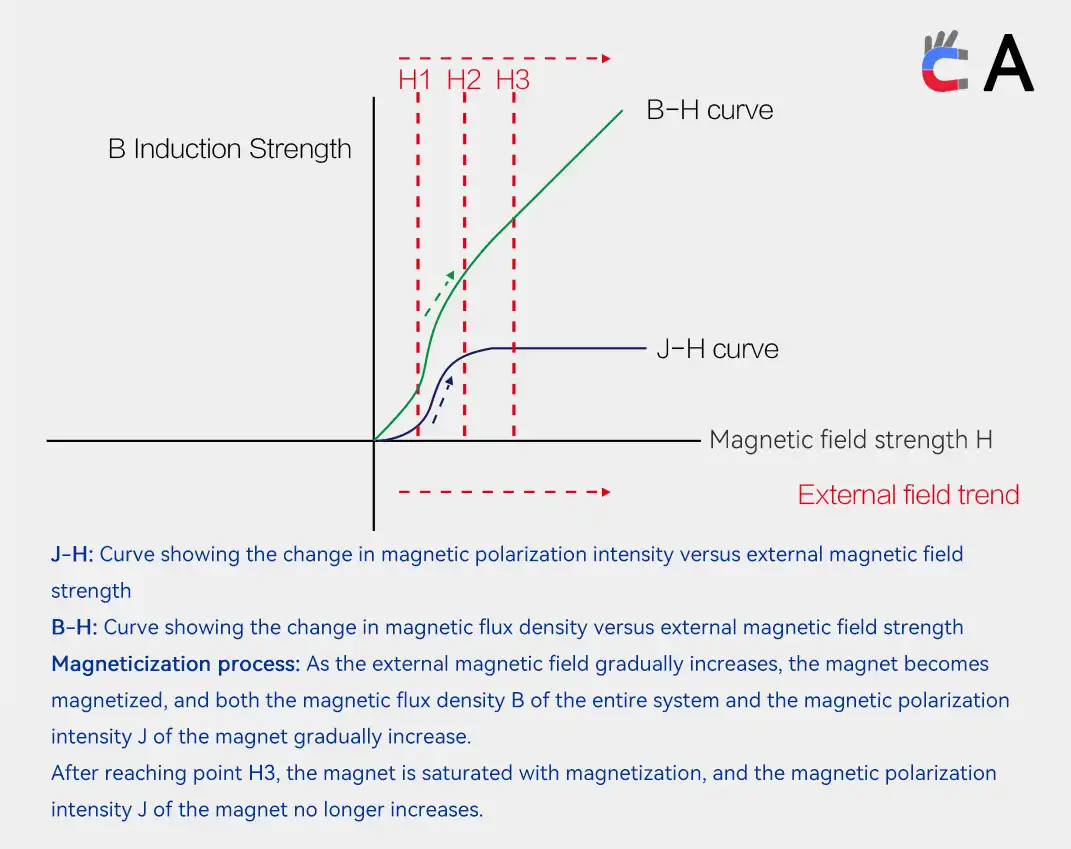
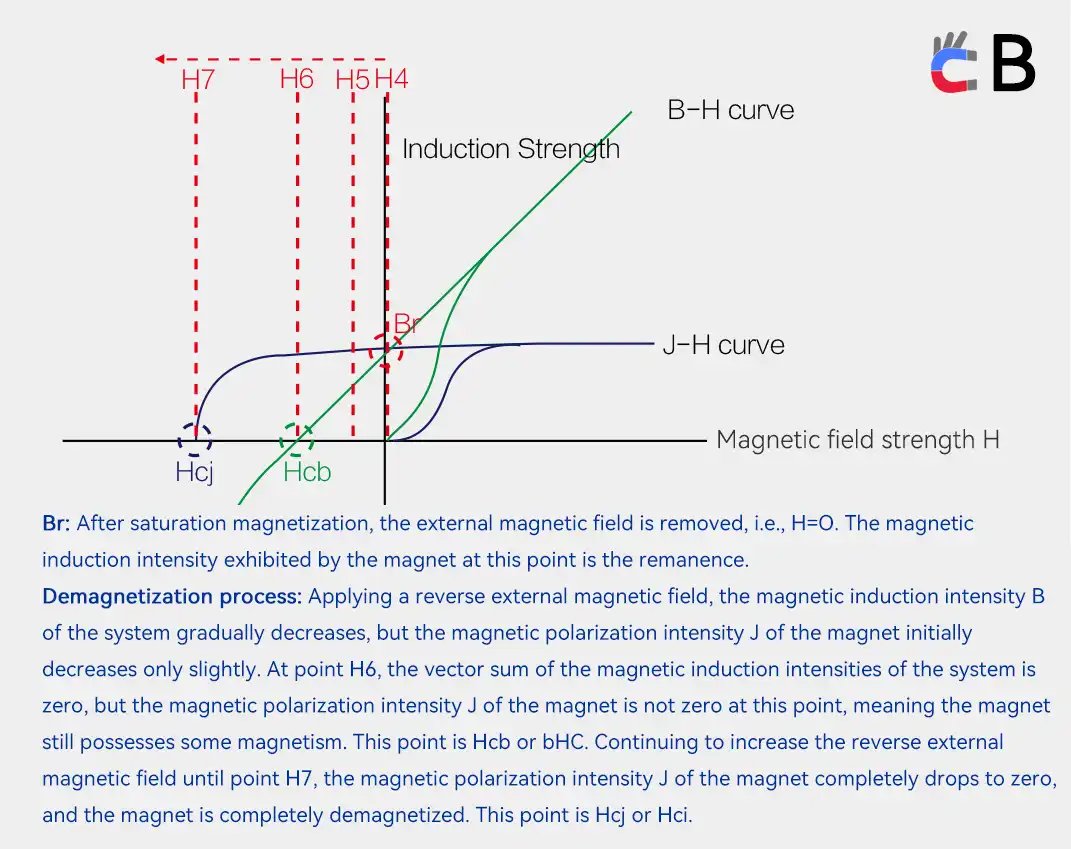
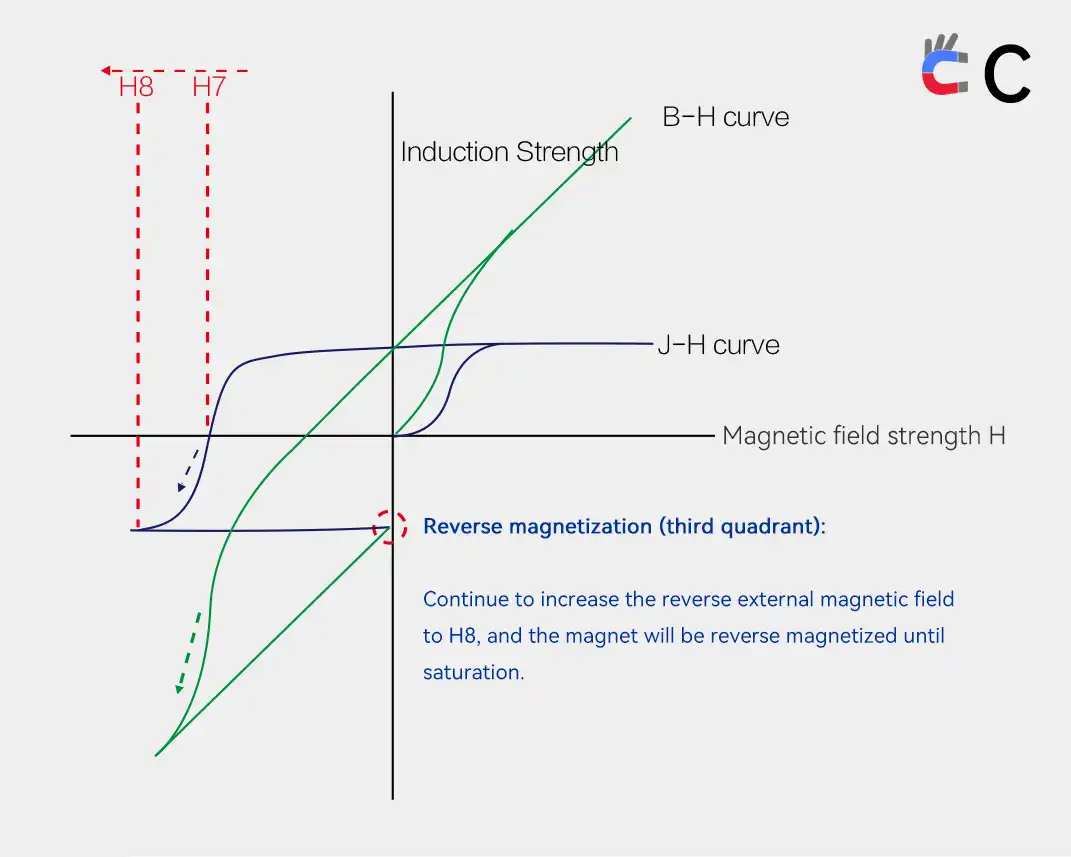
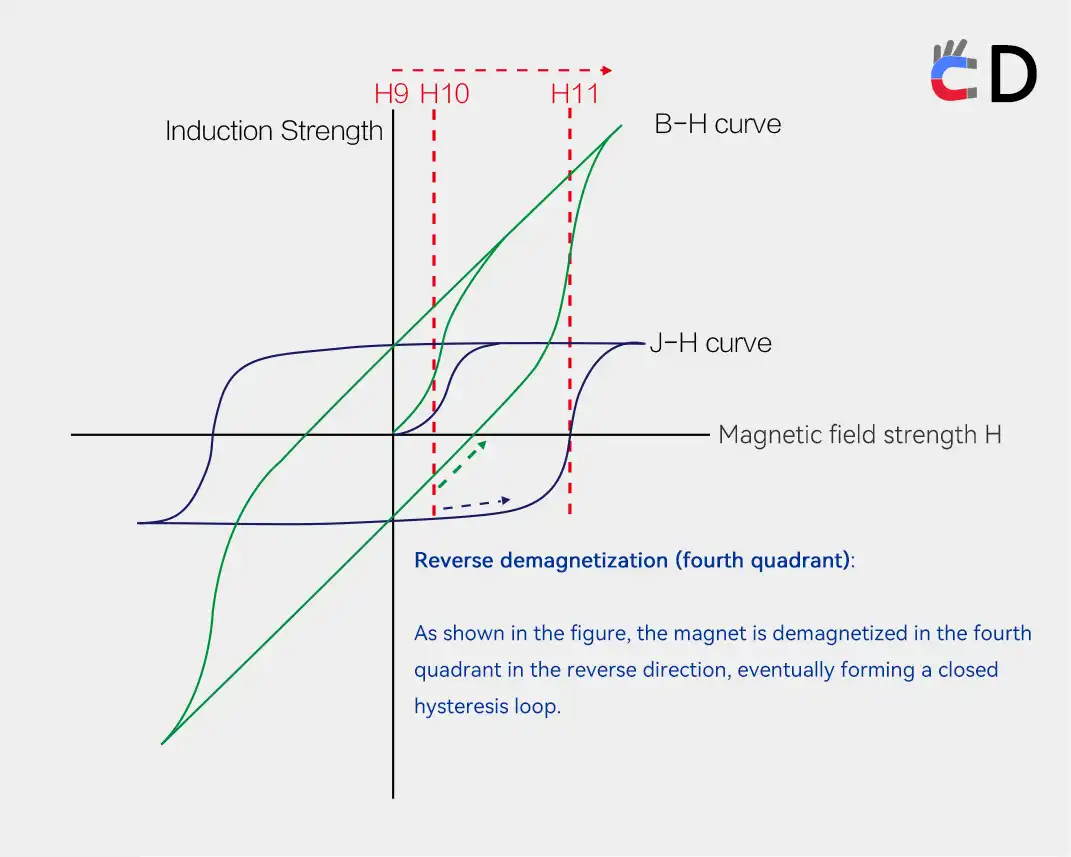
A: Hysteresis loop is a closed curve obtained for a magnetic material by plotting corresponding relationship between magnetic induction, B(vertical coordinates) and magnetizing force, H(horizontal coordinates) when the magnetic material is passing through a complete cycle of magnetizing, demagnetizing, reverse magnetizing and reverse demagnetizing.
Q7: What is the Demagnetization Curve?
A: Demagnetization curve is the second quadrant of the hysteresis loop.
Part 3: Key Performance Indicators (KPIs)
Q8: What does Residual Induction (Br) tell us?
A: Residual induction (or flux density), Br, is the magnetic induction corresponding to zero magnetizing force in a magnetic material after saturation magnetizing in a closed circuit; measured in Gauss or Tesla.
Q9: What is Coercive Force (Hc/Hcb)?
A: Coercive force (Hc, also known as Hcb or bHc) is equal to the demagnetizing force required to reduce induction field, B, to zero after the magnet has previously been saturation magnetized, measured in Oersteds (Oe) or Amperes per meter (A/m). In this case, the magnet’s magnetization strength is not zero. If the external magnetic field is revoked at this moment, the magnet can still show some magnetism.
Q10: Why is Intrinsic Coercive Force (Hci/Hcj) important?
A: Intrinsic coercive force (Hci/Hcj) is equal to the demagnetizing force required to reduce magnetization strength of the magnet to zero after the magnet has previously been saturation magnetized, measured in Oersteds (Oe) or Amperes per meter (A/m).
Q11: What is the Maximum Energy Product (BH)max?
A: Energy product is the product of B and H corresponding to any point in the demagnetization curve. It indicates the energy that a magnetic material can supply to an external magnetic circuit when operating at any point on its demagnetization curve; measured in J/m3 or GOe. (BH)max, or Maximum energy product, is the maximum value of product (BxH) which can be obtained on the demagnetization curve.
Q12: What is the "Hk" or Knee point coercive force?
A: Hk of J-H curve: there is a critical point defined as Hk for demagnetizing force. When the demagnetizing force reaches to Hk, J-H curve ceases to be linear.
📚 Extended Reading
Whether you are a beginner or an advanced engineer, explore our complete series of magnetic design guides:
-
Beginner:
Basic Magnetism FAQ: Materials & Magnetic Circuits -
Intermediate:
Magnetic Properties FAQ: H, B, M & B-H Curves Explained -
Advanced:
Advanced Magnet Design FAQ: Load Lines, Pc & Flux Loss
🌟Feel free to share! Please credit the source.
:) Let's help more people together.