
 Deutsch
 Русский
 Español
 Français
 한국어
한국어 日本語
日本語
Welcome to CCmagnetics, fellow tech enthusiasts and junior engineers!
Are you stepping into the fascinating world of permanent magnets for the first time? Don't worry if the jargon seems overwhelming. In this beginner-friendly FAQ guide, we’re going to break down the essential concepts of magnetic materials, their directions, and how magnetic circuits work. Let’s dive in and demystify magnetism together! 🌍💡
🛠️ Part 1: All About Magnetic Materials
Q1: What exactly is a Permanent Magnetic Material?
A: Simply put, it's the magnetic material which has high coercivity force. Permanent magnetic material needs strong external magnetic field when being magnetized, won’t easily lose its magnetic properties after saturated magnetization, and can provide stable magnetic field for exterior space.
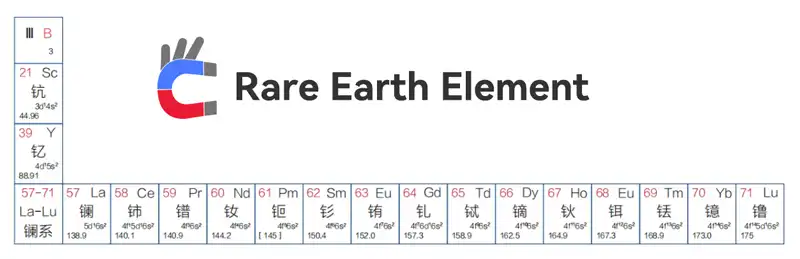
Q2: What are Rare Earth Elements (REE) and why do they matter?
A: Rare earth element (REE), is one of a set of seventeen chemical elements in the periodic table, specifically the fifteen lanthanides, as well as scandium and yttrium. Rare earth elements are lanthanum (La), cerium (Ce), praseodymium (Pr), neodymium (Nd), promethium (Pm), samarium (Sm), europium (Eu), gadolinium (Gd), terbium (Tb), dysprosium (Dy), holmium (Ho), erbium (Er), thulium (Tm), ytterbium (Yb), lutetium (Lu), scandium (Sc), and yttrium (Y).
🧭 Part 2: Magnet Directionality Explained
Q3: Isotropic vs. Anisotropic Magnets: What's the difference?
A: It all comes down to direction!
- Isotropic magnet: A magnet whose magnetic properties are the same in any direction.
- Anisotropic magnet: A magnet who has different properties in different directions and also has a preferred magnetization direction. Sinter NdFeB magnet is one kind of anisotropic magnet.
Q4: What does "Orientation Direction" mean?
A: Orientation direction is the direction in which an anisotropic magnet could be magnetized with the most optimum magnetic properties. Also known as “orientation axis”, “easy magnetizing axis”.
🔌 Part 3: Magnetic Circuits & Measurement
Q5: How does a Magnetic Circuit work?
A: The circuit through which the magnetic flux flows is called a magnetic circuit. Permanent magnets, magnet yoke, air gaps, magnetic pole shoe, etc. constitute a closed magnetic circuit.
Q6: What is the difference between Open and Closed Circuit conditions?
A:
- Open circuit condition: Exists when a magnetized magnet is isolated from ferromagnetic components that are commonly found in the magnetic circuit.
- Closed circuit condition: Exists when the external flux path of a permanent magnet is confined within flux conducting material.
Q7: What is an Air Gap?
A: Air gap is a low permeability (normally close to 1) gap in the flux path of a magnetic circuit. Often air, but inclusive of other materials.
Q8: What happens to flux that gets lost? (Leakage Flux)
A: We call it Leakage Flux: A portion of the flux that doesn’t pass through the air gap, or useful part of the magnetic circuit.
Q9: How do we measure the Superficial/Surface Magnetic Field (Gs)?
A: Superficial/Surface magnetic field is the magnetic flux density of some point on magnet surface or in surrounding space. It can be measured through Hall probe. Hall component can output a voltage signal under magnetic field. The voltage and magnetic flux density have linear relationship.
📚 Extended Reading
Whether you are a beginner or an advanced engineer, explore our complete series of magnetic design guides:
-
Beginner:
Basic Magnetism FAQ: Materials & Magnetic Circuits -
Intermediate:
Magnetic Properties FAQ: H, B, M & B-H Curves Explained -
Advanced:
Advanced Magnet Design FAQ: Load Lines, Pc & Flux Loss
🌟Feel free to share! Please credit the source.
:) Let's help more people together.