
 Deutsch
 Русский
 Español
 Français
 한국어
한국어 日本語
日本語
Welcome to the final frontier, Master Engineers!
If you are designing complex permanent magnet motors, sensors, or sophisticated magnetic assemblies, this advanced FAQ is for you. Here, we tackle the nitty-gritty of operating points, permeance coefficients, irreversible losses under high temperatures, and system dynamics. Let's solve those tough engineering questions! 🚀
🎯 Part 1: Operating Points & Load Lines
Q1: How do we determine the Working Point and Load Line in an open circuit?
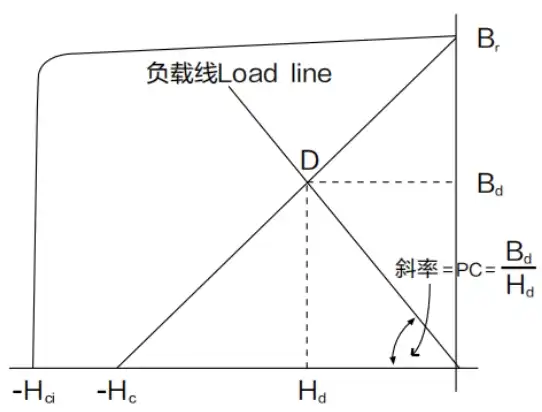
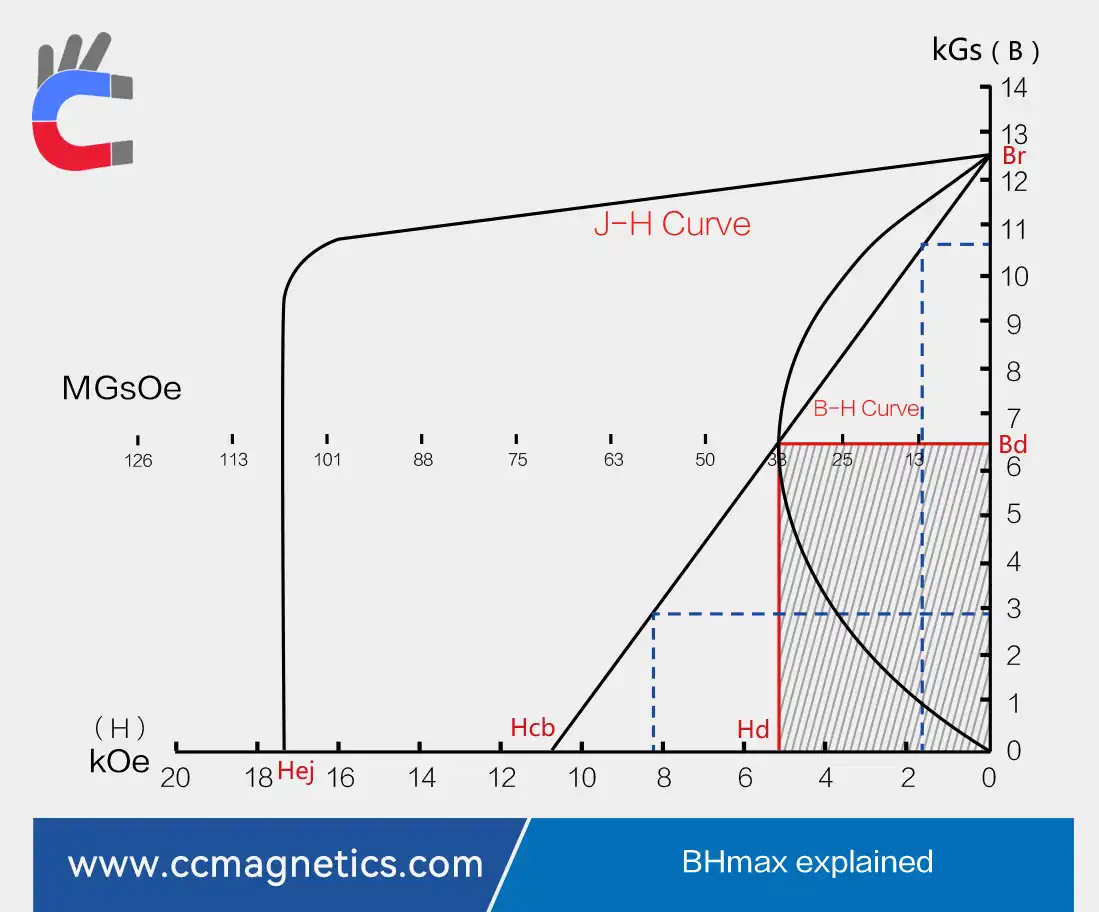
A: Working point, Load Line or Operating line: when the magnet is working under open circuit condition, since the effect of demagnetization field, the induction strength of the magnet in working condition is not the Br under closed circuit condition, actually, it’s some point in the B-H curve which is lower than Br. This point is defined as working point, D, as shown in the following picture.
The straight line drawn between the working point and the origin is called Load line, which is also known as operating line. The slope of this line is defined as Pc.
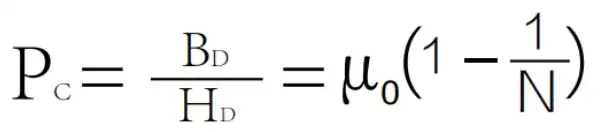
Pc=Bd/Hd=*(1-1/N). N is called the average demagnetization factor.
Q2: What is the Permeance Coefficient (Pc) and how is it calculated?
A: Permeance coefficient (Pc): Pc=Bd/Hd or slope of the operating line, the ratio of magnetic induction, Bd, to a demagnetizing field, Hd.
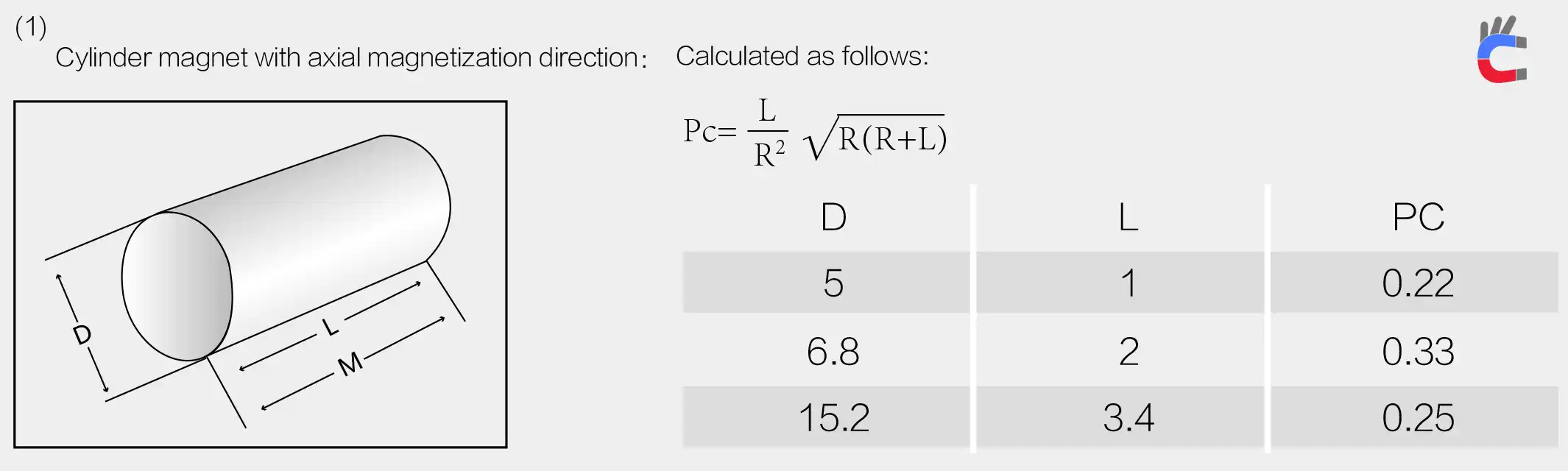
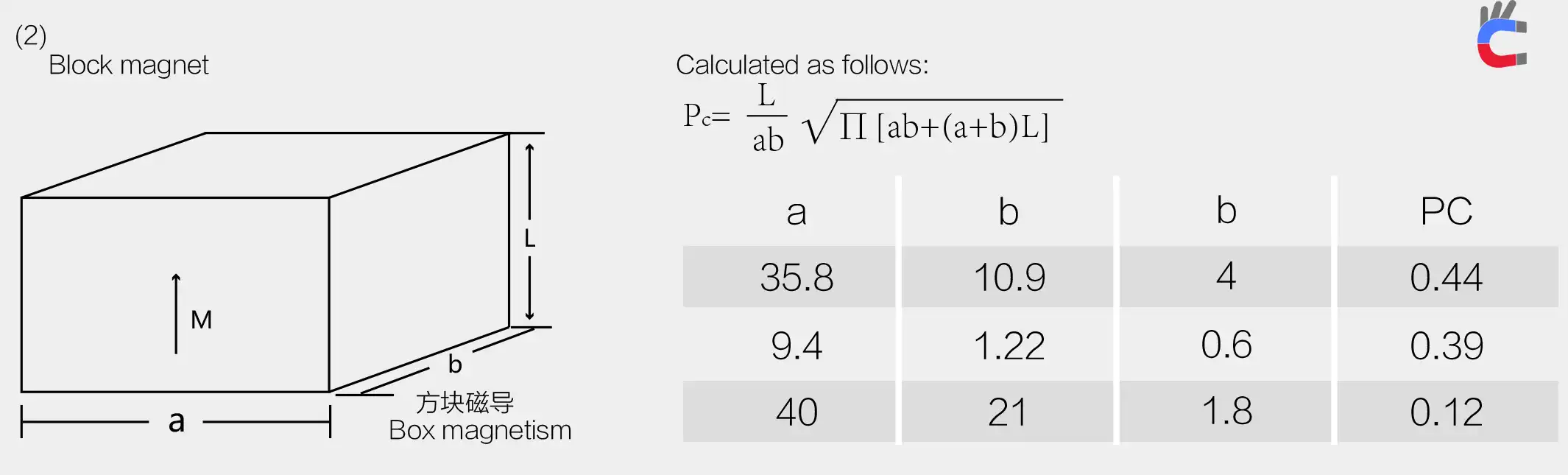
Pc of some certain magnet is only related with the magnet shape and dimensions. Higher Pc means that magnet has higher operating point, which also means it’s more difficult to demagnetize the magnet. Normally, if the magnet has relatively longer dimension in magnetized direction, it has higher Pc.
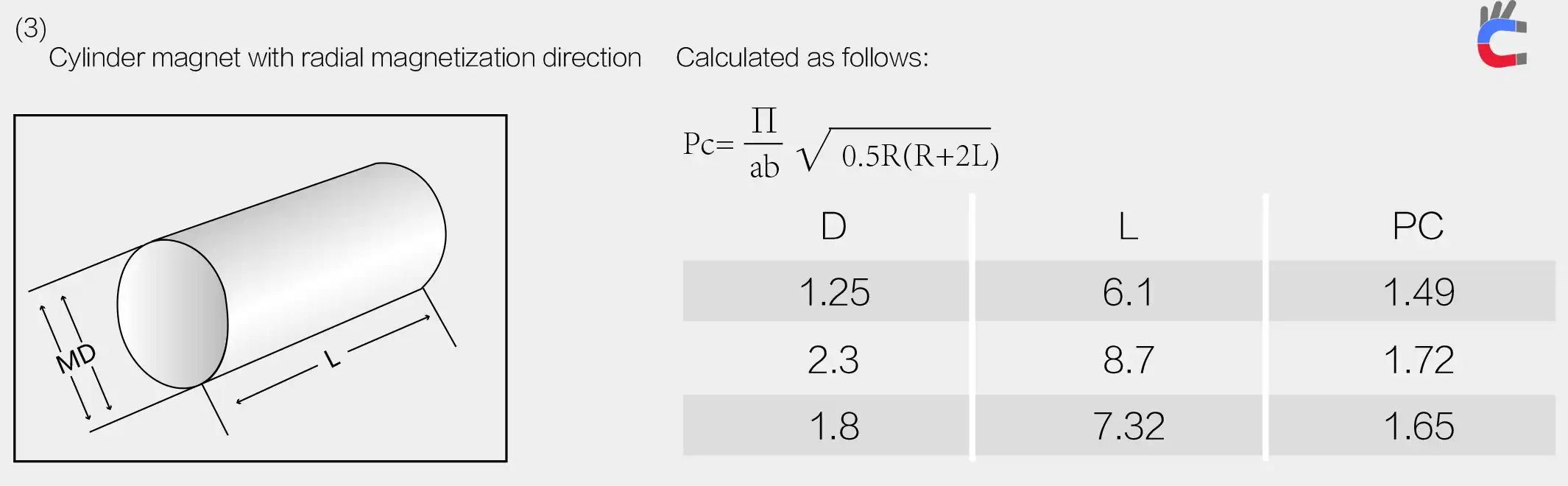
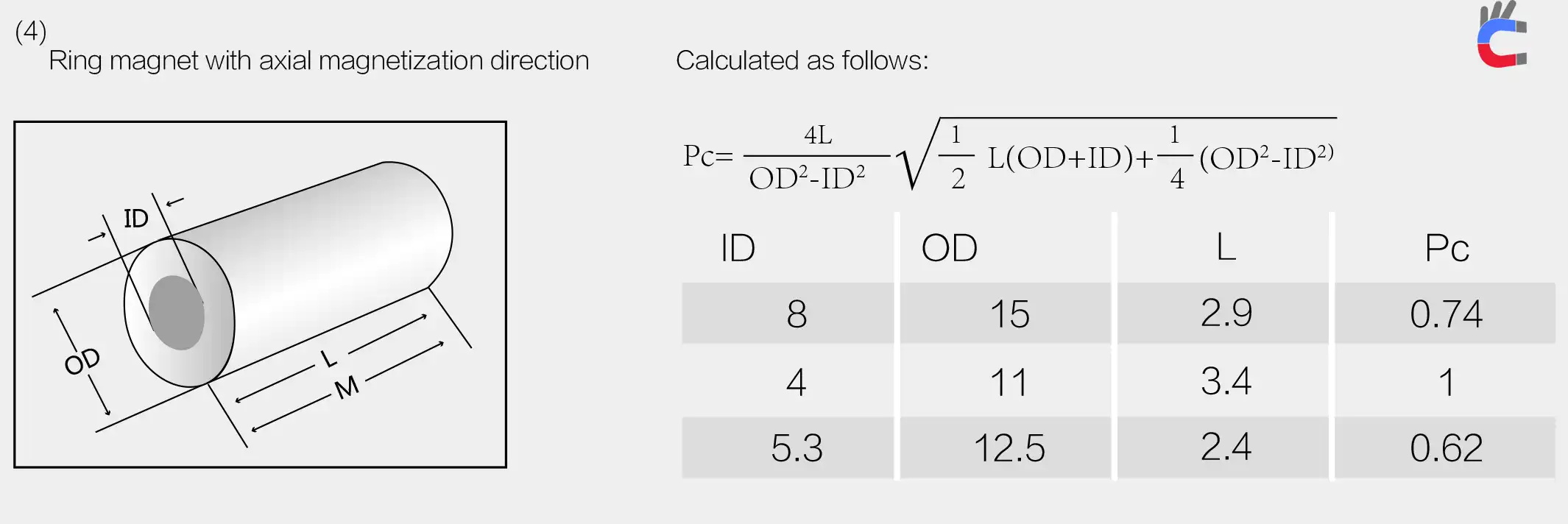
Pc values have different calculation formulas for different shapes, here are some examples:
🔥 Part 2: Advanced Permeability & High-Temperature Behavior
Q3: What happens when a magnet exceeds the "Knee" of the BH curve? (Irreversible Loss)
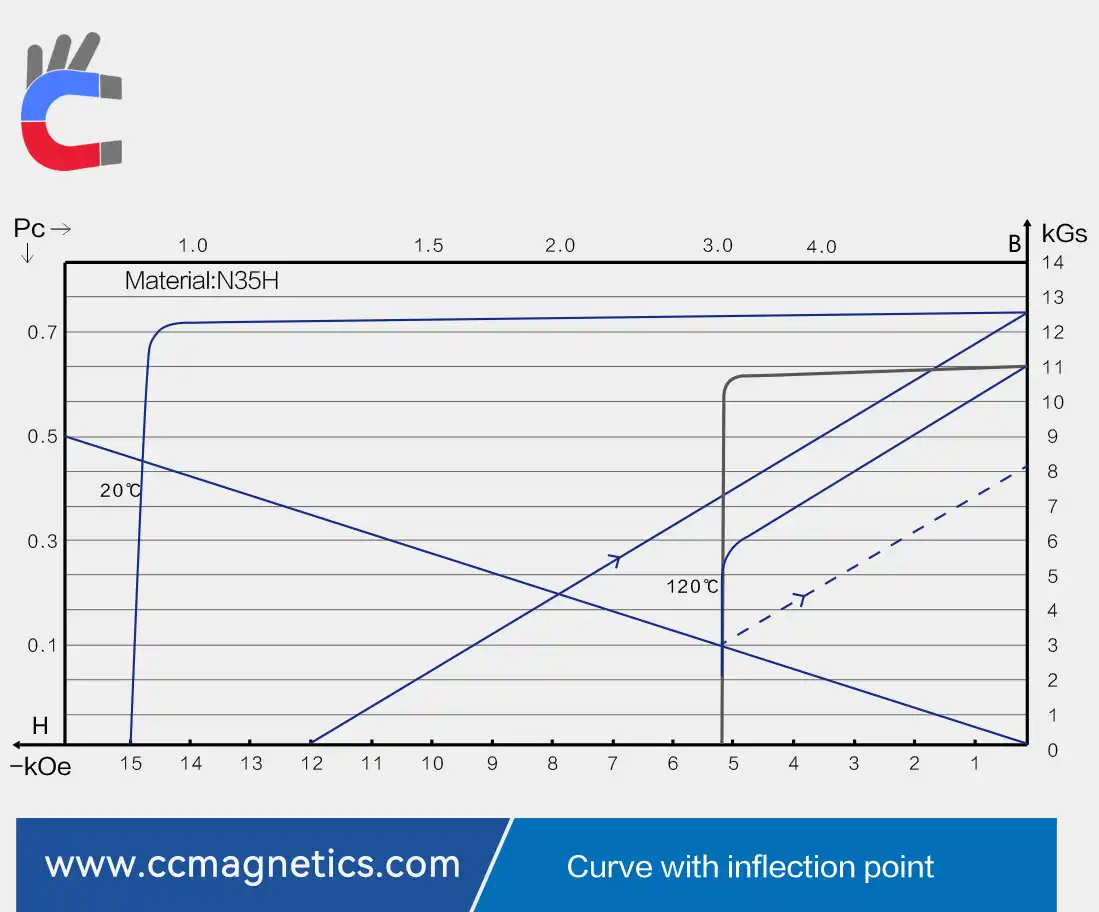
A: Knee of the BH curve is the point at which the B-H curve ceases to be linear. All magnet materials, even if their second quadrant curves are straight line at room temperature, develop a knee at some temperature. If the operating point of a magnet falls below the knee, small changes in H produce large changes in B, and the magnet will not be able to recover its original flux output without re-magnetization.
Let's look at a real-world example using N35H:
If a Pc=0.5 line is drawn on the typical B-H curves of N35H NdFeB, the intersection with the B-H curves under 20 and 120 degrees would represent the Operating points at 20 and 120 degrees respectively. In the actual application, when the Pc increases above 0.5, the Operating Point for 20 degrees move back and forth at the slope of Recoil Permeability, approximately along the B-H curve of 20℃. But, under 120 degrees, the Operating Point moves along a line at a slope of the Recoil Permeability which is substantially below the B-H curve of 120℃. There exists irreversible loss due to “exceeding the Knee” of the B-H curve.
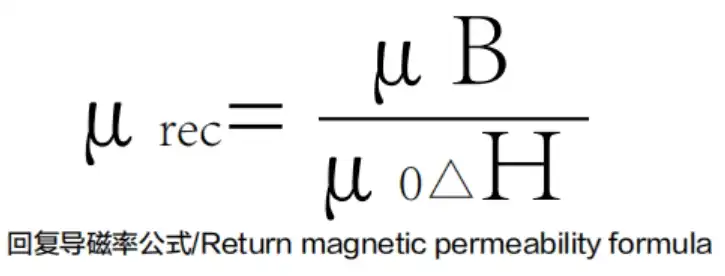
Q4: What is Recoil Permeability (μrec)?
A: Recoil Permeability (μrec): when exerting a small scale of cyclic magnetic field with positive and reverse direction, ±ΔH, on ferromagnetic material under some constant external magnetic field, it will cause the variation of the magnetic flux density. μrec is defined by △B and △H according to the following formula. It reflects the stability of magnetization status inside the magnetic material under the influence of external magnetic field.
Q5: How do we define Relative Magnetic Permeability (μr)?
A: Relative magnetic permeability (μr) is the ratio of medium permeability to vacuum permeability. μr = μ/μ0. In the CGS system of units, μo=1. The relative magnetic permeability of air is usually used as 1 in practical application. In addition, the relative magnetic permeabilities for Cu, Al and stainless steel material approximate to 1.

Uncategorized
Q6: What is Magnetic Permeance?
A: Magnetic Permeance is the ratio of flux Φ to magnetic motive force F. It is similar with the concept of electric conductance in electric circuit. It reflects the ability of magnetic conductivity of the material.
Q7: What is a Magnetic Moment (Magnetic dipole moment)?
A: Magnetic moment (magnetic dipole moment): (1) for magnetic dipole, magnetic dipole moment is the product of electric current, loop area and unit vector which is normal to the loop plane; (2) for the substance in a given area, Magnetic moment is the vector sum of all the basic magnetic dipole moments. There only exists a difference of coil coefficient between magnetic flux and magnetic moment. Magnetic moment can be measured through Helmholtz coil.
🌡️ Part 3: System Limits & Losses Explained
Q8: What are the absolute temperature limits (Tc and Tw) for a magnet?
A:
- Curie Temperature (Tc): Is the temperature at which ferromagnetic materials lose its magnetic properties.
- Maximum Working temperature Tw: The maximum temperature under which the magnet can still meet the working requirement. The actual Tw of some magnet is influenced by many factors, so it’s undetermined value. In another word, a same magnet can have different Tw under different applications.
Q9: How do Temperature Coefficients (αBr and βHcj) work?
A:
- Br temperature coefficient (αBr): Is a factor which describes the reversible change in residual magnetic flux intensity with a change in temperature.
- Hcj temperature coefficient (βHcj): Is a factor which describes the reversible change in Intrinsic coercive force with a change in Temp.
Q10: What is Flux Loss? (Reversible vs. Irreversible)
A:
- Reversible loss: Under certain condition, the magnet may have some flux loss caused by exposure to external factors. But when the external factors are revoked, the magnet flux can be fully recovered to the original status. This kind of loss is called reversible loss.
- Irreversible loss: Refers to the partial demagnetization or loss of the magnet, caused by exposure to high temperatures, external magnetic fields or other factors. Once it occurs, the only way to regain the flux loss is to re-magnetize the magnet.
Q11: What are Eddy Currents and why are they harmful?
A: Eddy currents are circulating electrical currents that are induced in electrically conductive elements when exposed to changing magnetic fields, creating an opposing force to the magnetic flux. Eddy currents may cause unwanted consequences for most designs of magnetic circuit, so eddy currents should be minimized as much as possible.
Q12: What does Magnetic Saturation mean?
A: (Magnetic) Saturation describes the state reached when an increase in applied external magnetic field H can’t increase the magnetization of the material further since the limit of material physical structure.
📚 Extended Reading
Whether you are a beginner or an advanced engineer, explore our complete series of magnetic design guides:
-
Beginner:
Basic Magnetism FAQ: Materials & Magnetic Circuits -
Intermediate:
Magnetic Properties FAQ: H, B, M & B-H Curves Explained -
Advanced:
Advanced Magnet Design FAQ: Load Lines, Pc & Flux Loss
🌟Feel free to share! Please credit the source.
:) Let's help more people together.