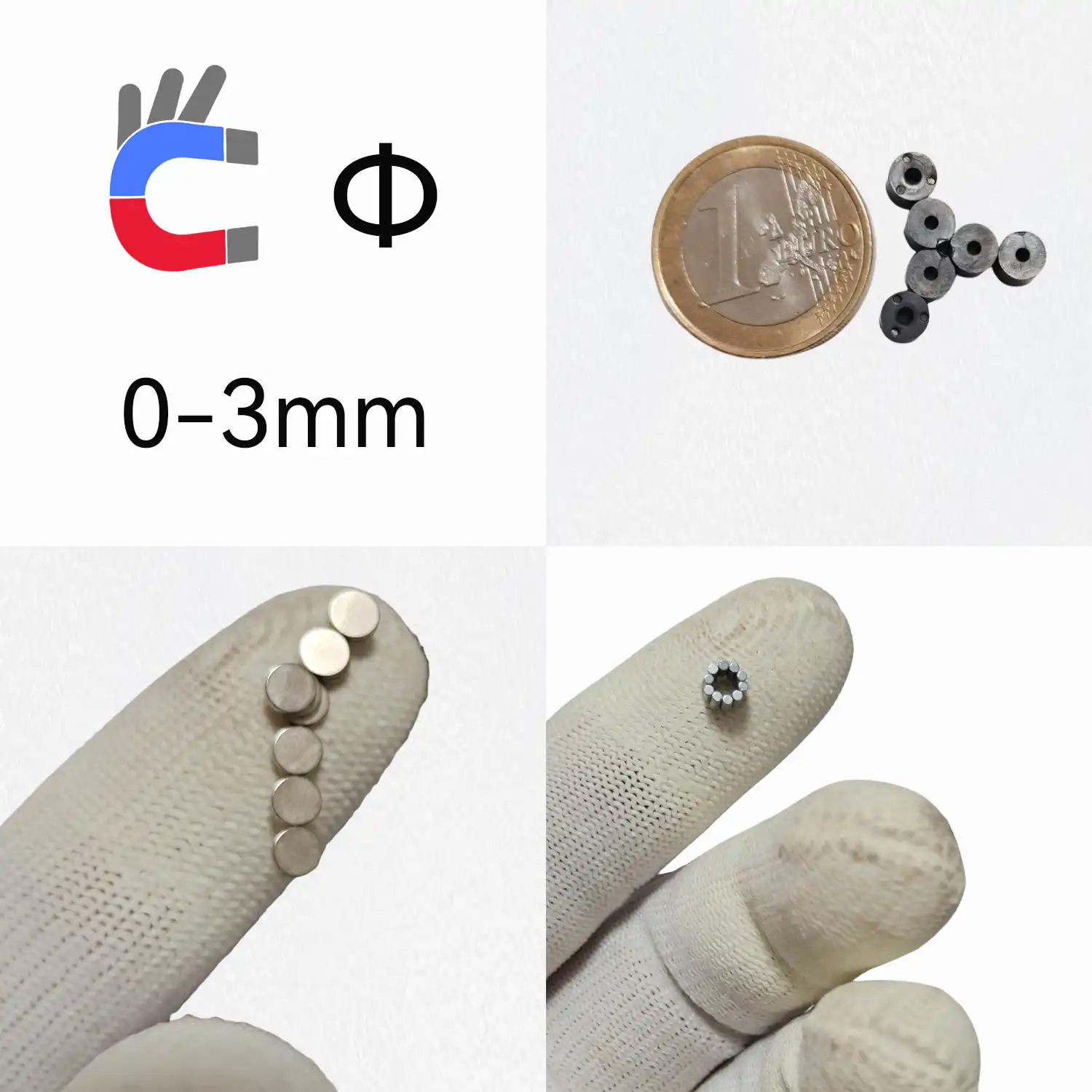
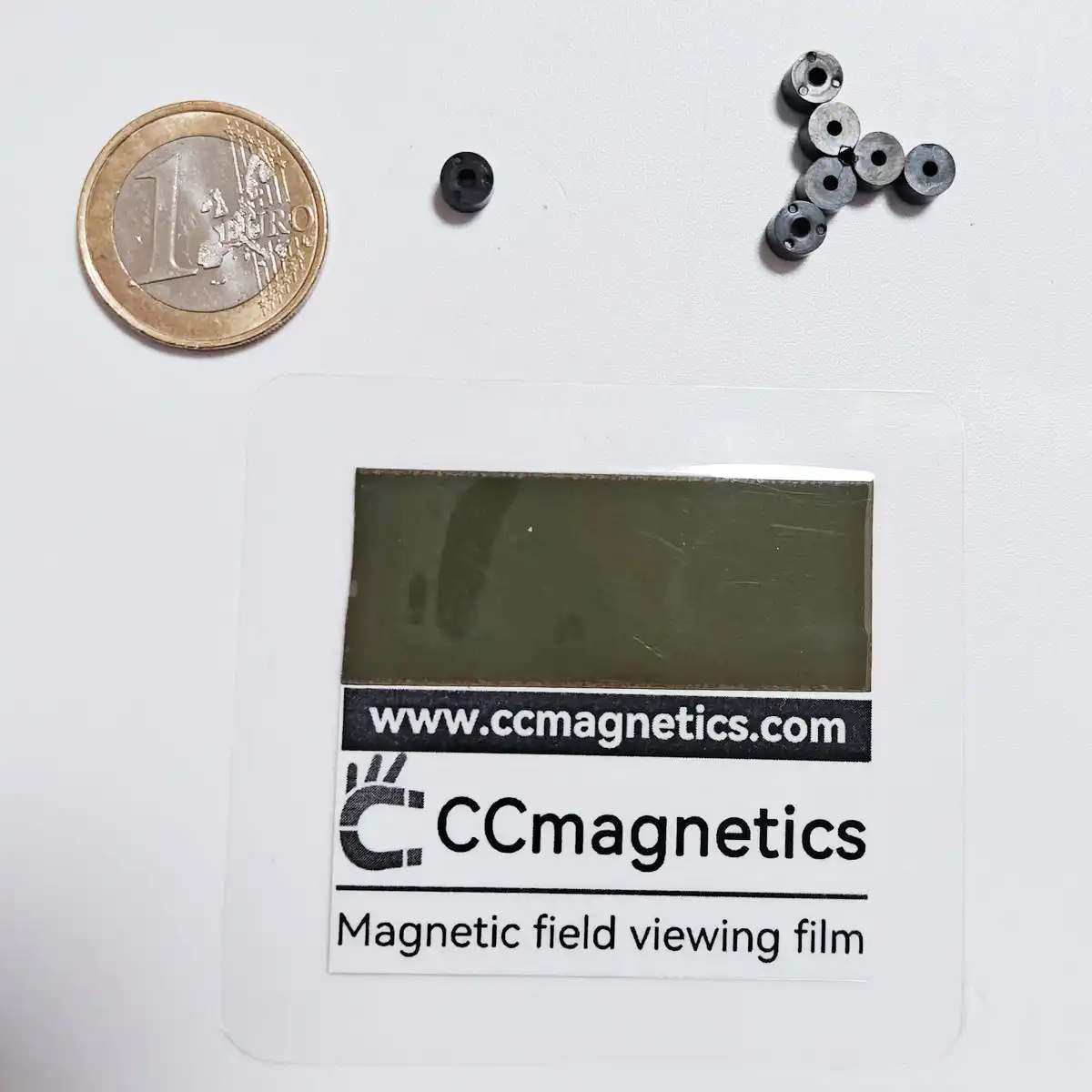
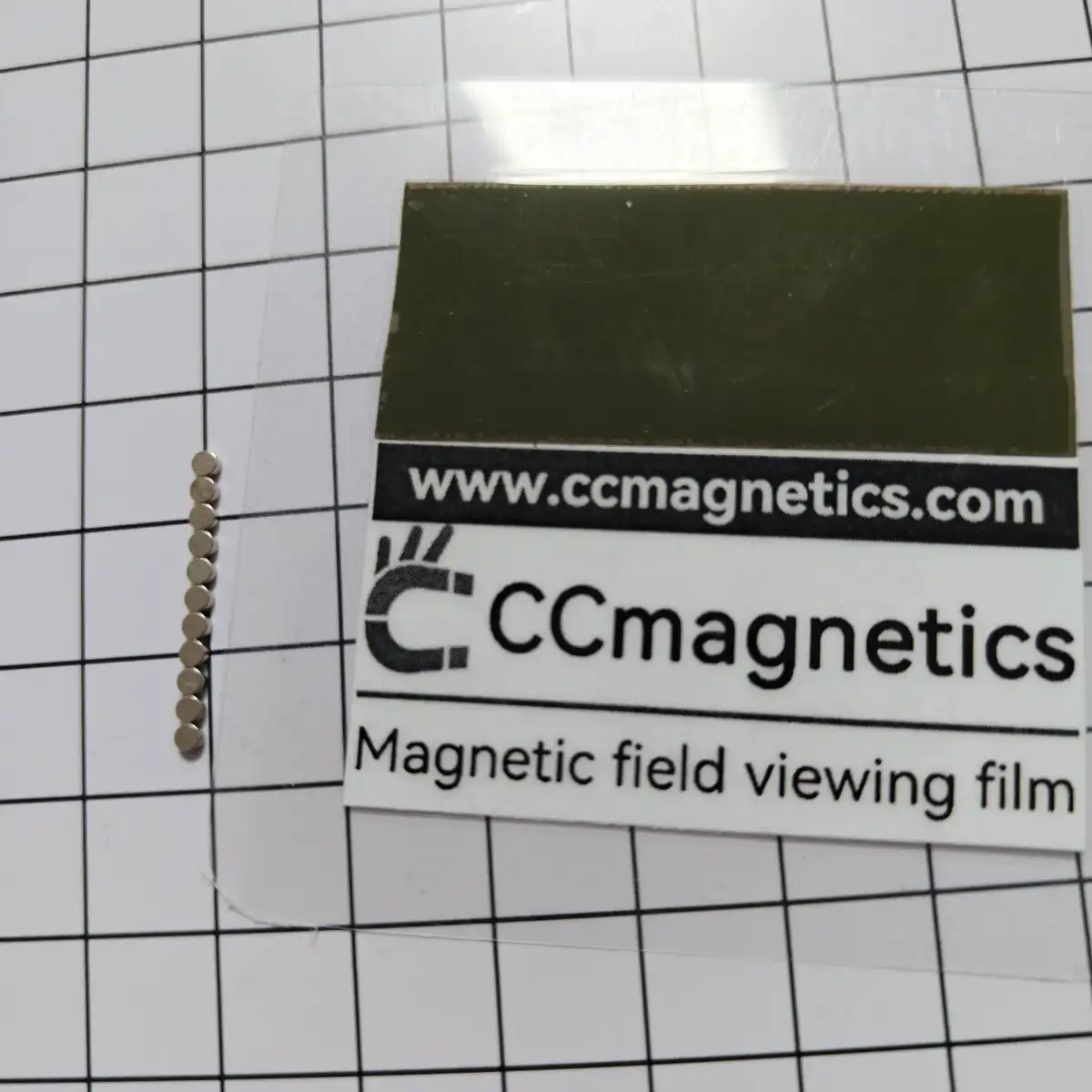
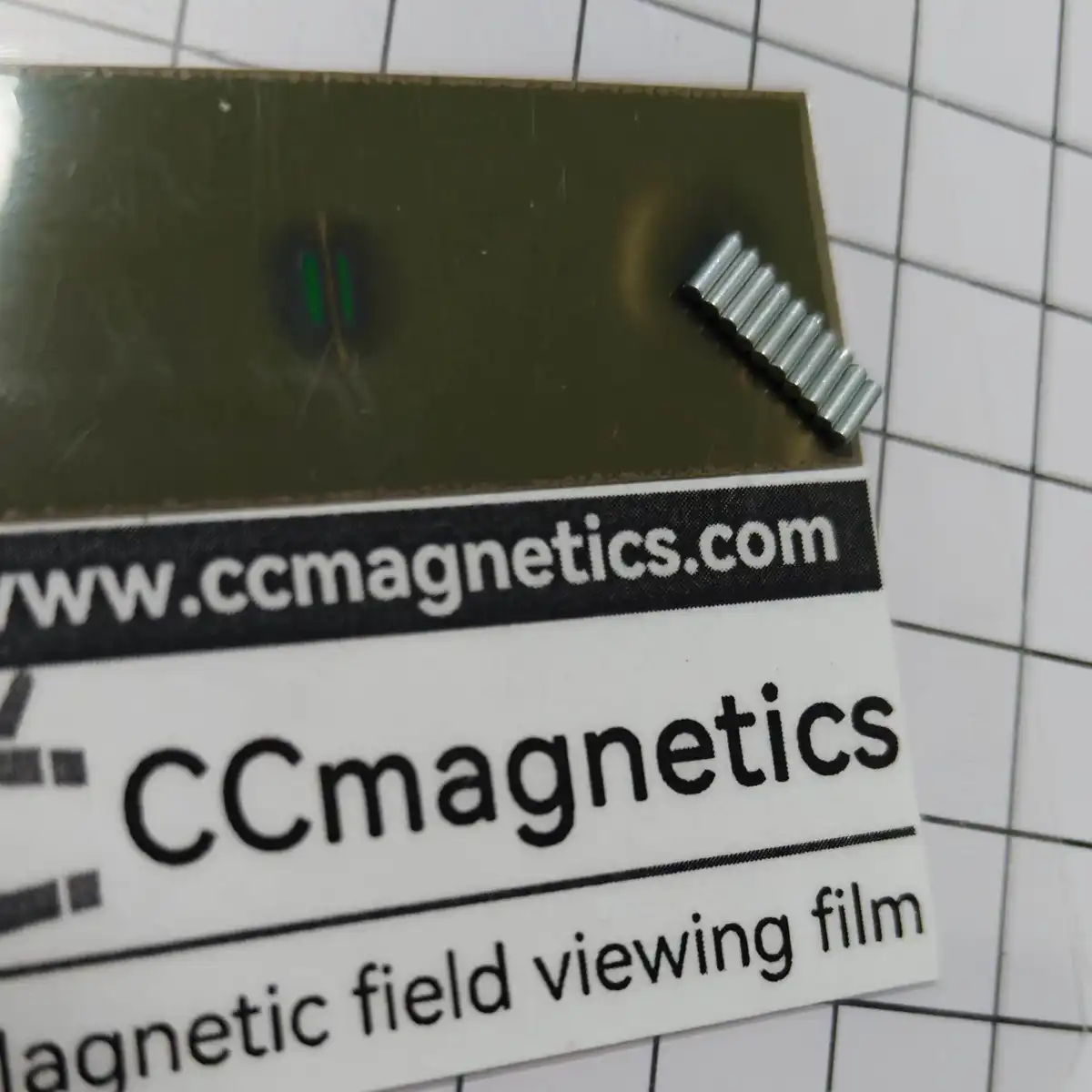
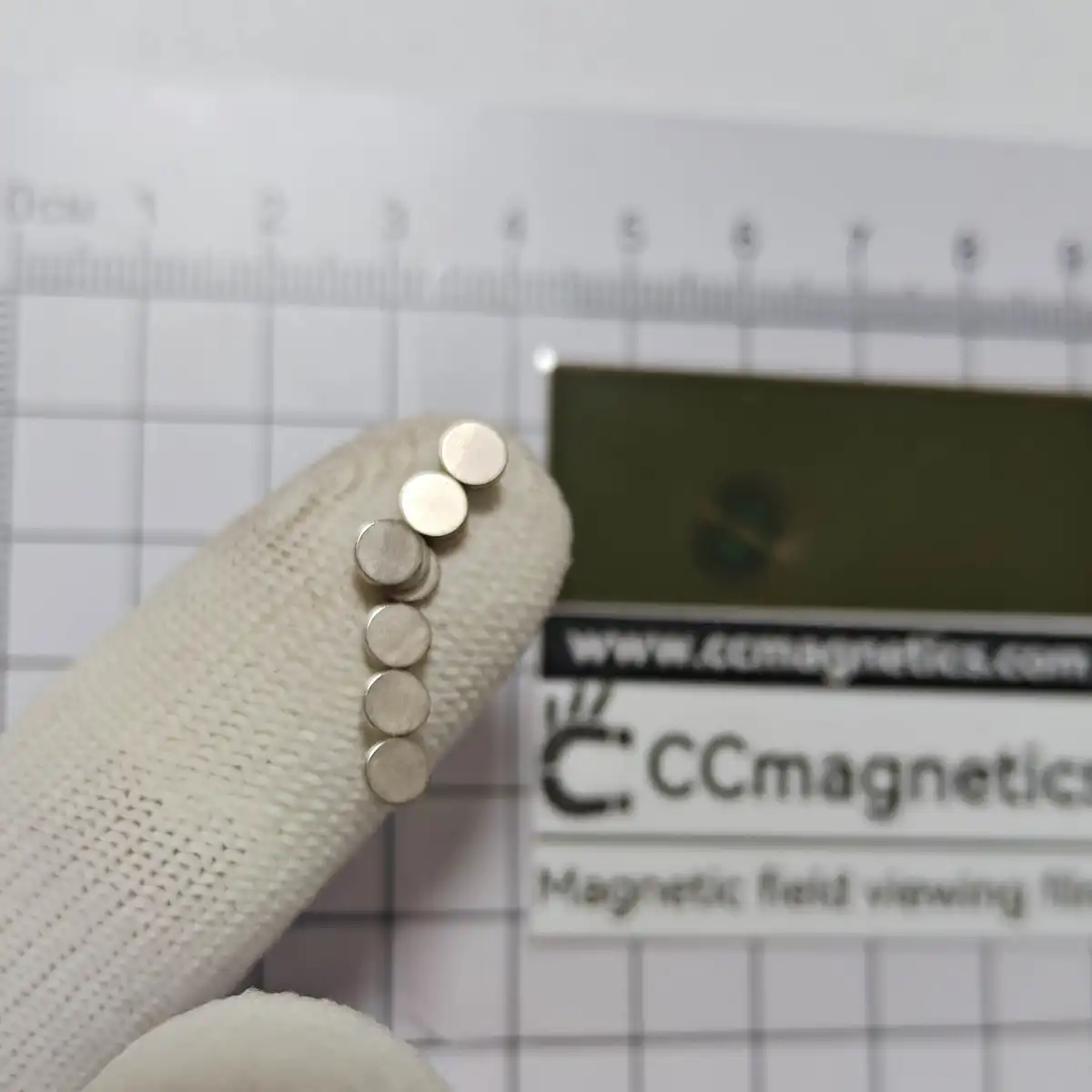
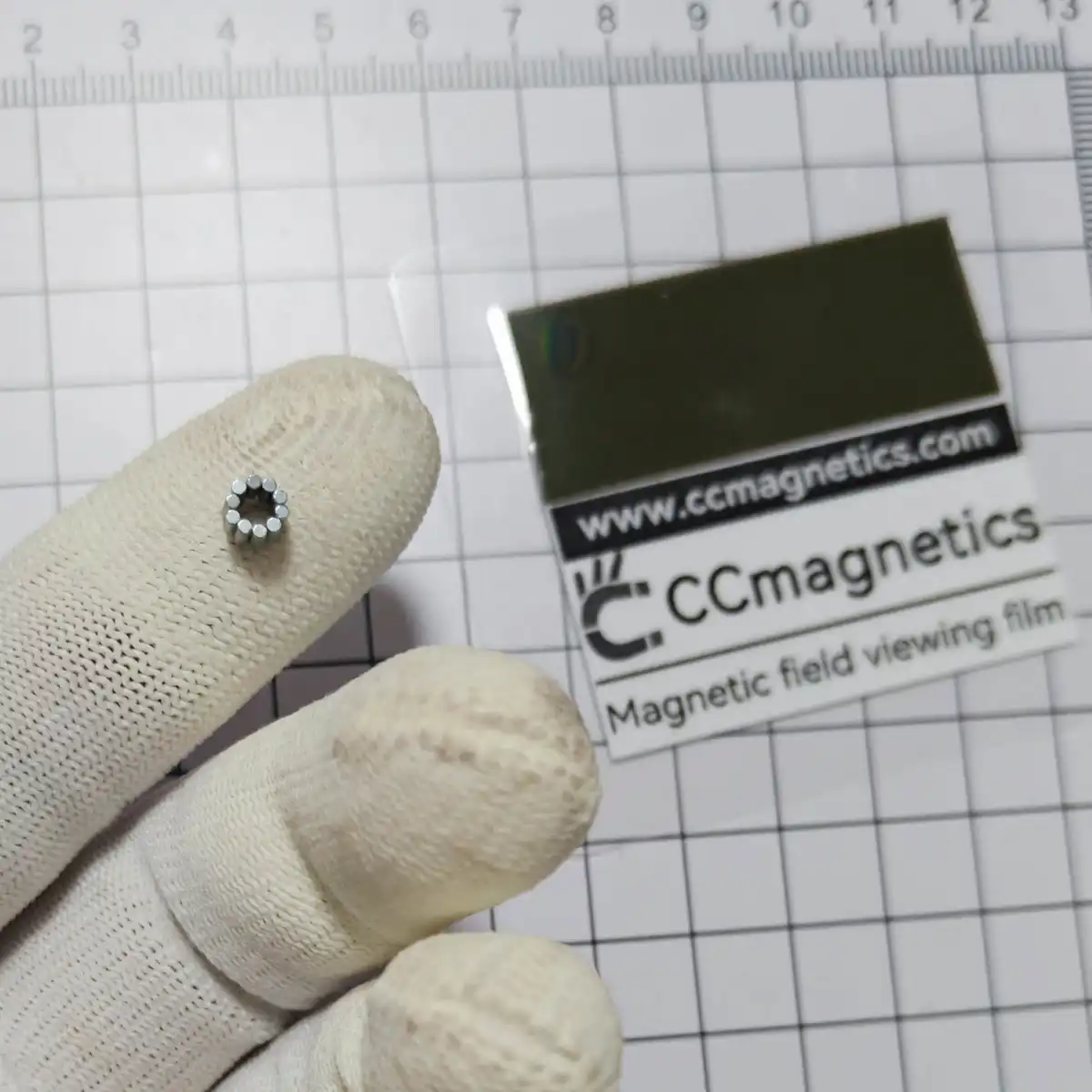
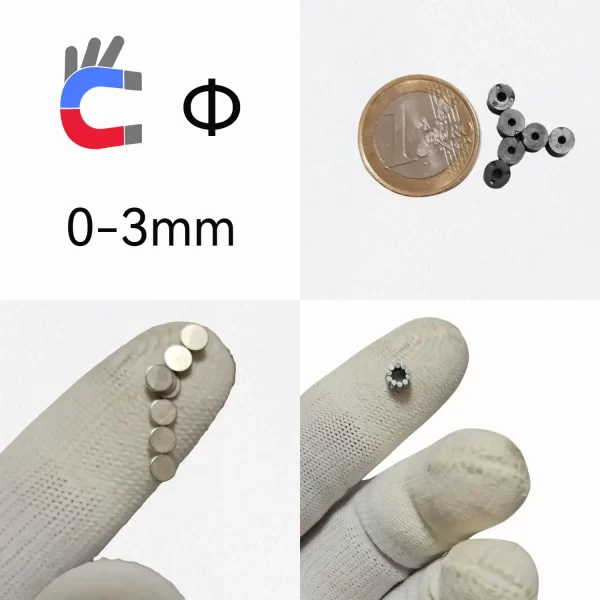
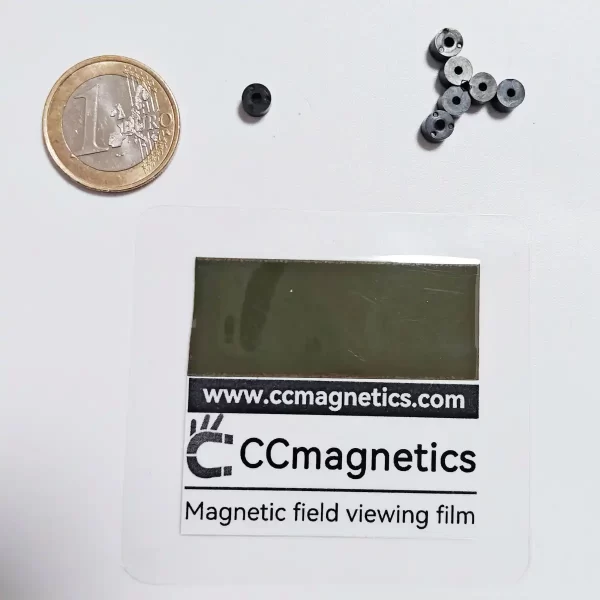
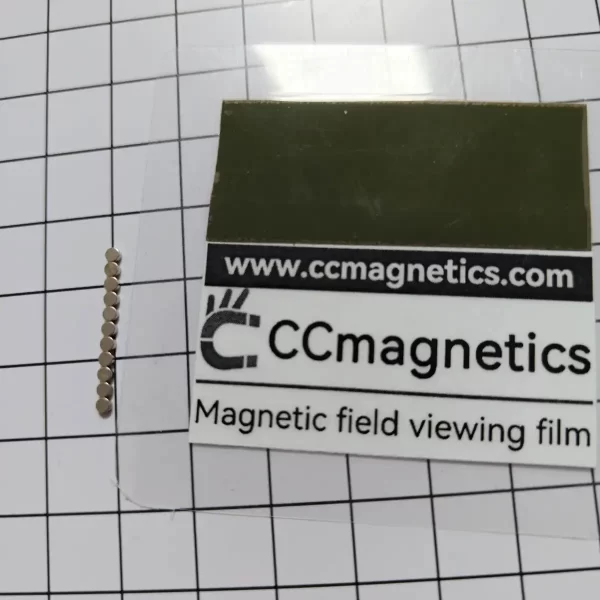
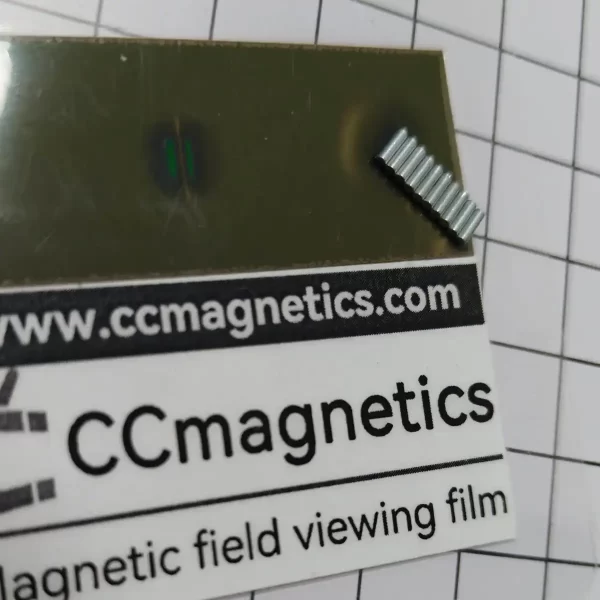
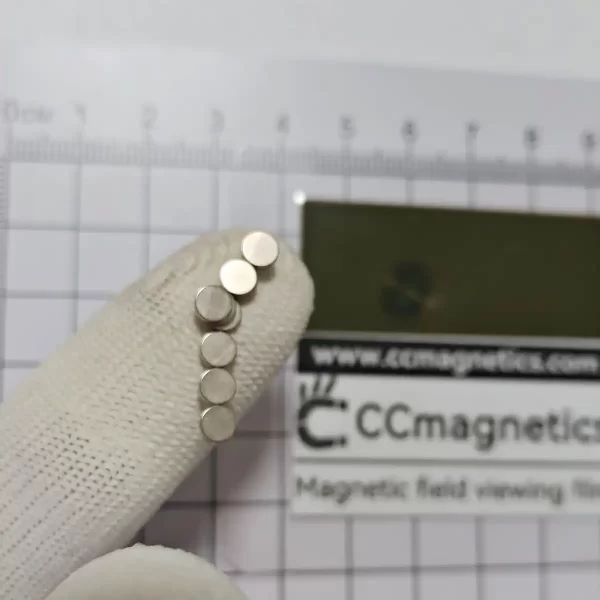
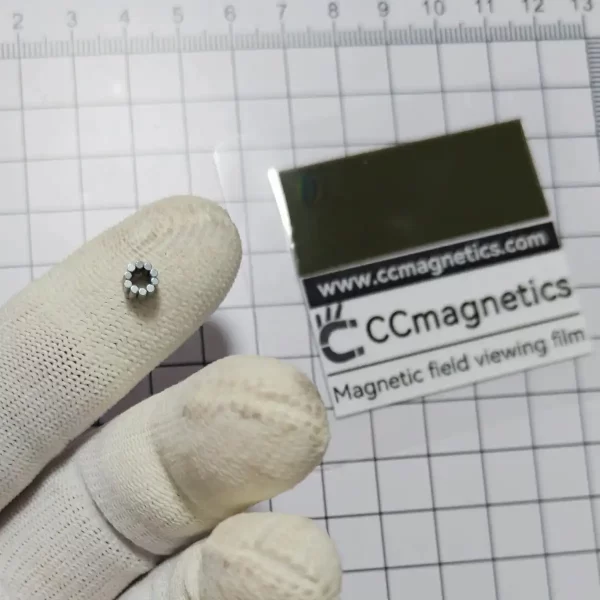
Cette liste propose une sélection d'aimants codeurs miniatures à 2 pôles de 0 à 3 mm de D.E. pour les dispositifs numériques et mécaniques. Les configurations incluent des cylindres pleins et des anneaux avec une aimantation axiale, radiale ou latérale. Fabriqués en NdFeB permanent, les grades disponibles vont de N35 à N52. Selon le numéro de pièce (PN) spécifique, les caractéristiques peuvent inclure des revêtements en Zn, Ni ou NiCuNi, et des variantes haute température (par exemple, N28AH) fonctionnant jusqu'à 220°C. Consultez les PN individuels pour connaître les spécifications exactes.
Aucun frais d'outillage inutile
Livraison porte-à-porte mondiale
Les tests avant livraison garantissent la précision

Mettez cette page dans vos favoris pour une R&D sans tracas.
Comprendre notre tableau des paramètres :
Méthode de magnétisation
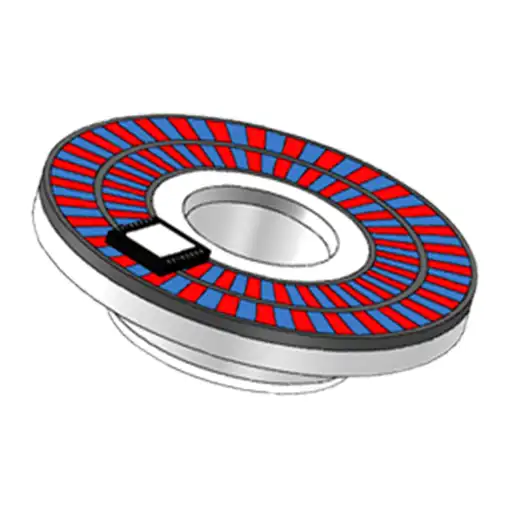
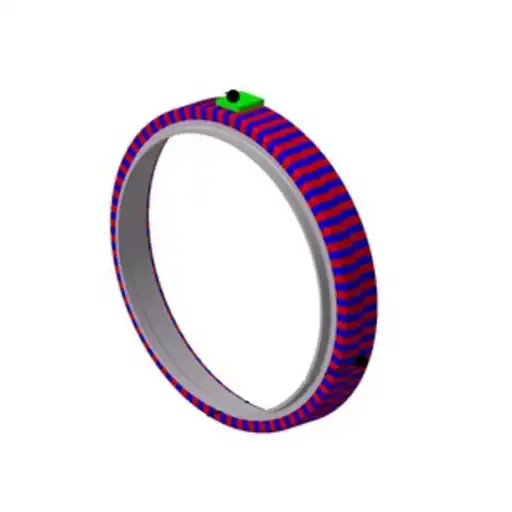
(Ex. MT/Nombre de pôles = 8 pôles)
(Ex. MT/Nombre de pôles = 2 pôles)
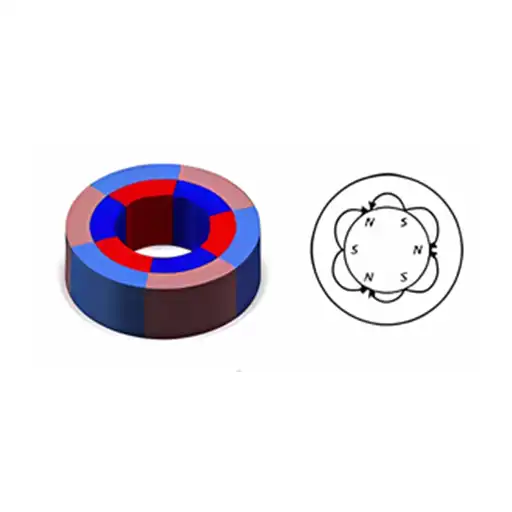
(Ex. MT/Nombre de pôles = 6 pôles)
Terminologie du tableau des paramètres :
| N° | Élément | Description | Remarques |
|---|---|---|---|
| 1 | PN | Numéro de pièce | Chaque aimant/anneau magnétique possède un PN unique. Les valeurs en double sont parfois causées par des différences dans les qualités des matières premières. |
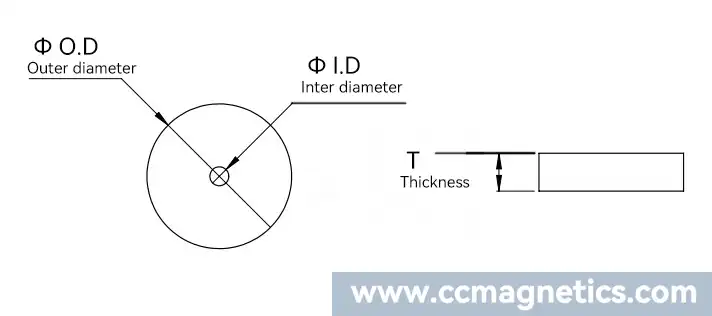
| 2, 3, 4 | O.D./I.D./T | Dimensions de l'anneau magnétique | Toutes les dimensions du tableau sont en millimètres. O.D = Diamètre extérieur I.D = Diamètre intérieur T = Épaisseur |
| 5 | MT | Nombre de pôles de la piste principale | Pour un anneau magnétique avec une seule piste, la piste principale représente le nombre de pôles magnétiques. Par exemple, « 10 pôles » signifie 5 paires de pôles. |
| 6 | NT | Piste Nonius : Orbite avec moins de pôles | Pour un anneau codeur magnétique à 2 pistes, la piste Nonius a généralement le nombre de pôles le plus faible. Le nombre de pôles sur la piste Nonius peut parfois être un nombre impair, comme 3 pôles. |
| 5 | MATL | Matériau de l'anneau magnétique | Il existe différents types de matériaux pour les anneaux magnétiques. Veuillez consulter la FAQ au bas de la page. |
| 6 | SF | Champ magnétique de surface | Cela fait référence à l'intensité du champ magnétique de surface. |
| 7 | MAG | Méthode d'aimantation | Les méthodes d'aimantation courantes sont répertoriées en haut de la page. |
| 8 | CMTS | Commentaires | Cette section fournit des informations sur l'utilisation, les caractéristiques et d'autres détails de l'anneau magnétique. |
| PN | O.D | I.D | T | MAG | MT | SF | MATL | CMTS |
|---|---|---|---|---|---|---|---|---|
| R0001 | 1 | 0 | 5 | Radial | 2 | 487~497mT | Neodymium magnets | - |
| R0508 | 1.2 | 0 | 4 | Radial | 2 | 459~469mT | Neodymium magnets | - |
| R0507 | 1.5 | 0 | 10 | Radial | 2 | 535~545mT | Neodymium magnets | - |
| R1484 | 1.5 | 0 | 1 | Radial | 2 | 187~197mT | Neodymium magnets | N52 |
| R1485 | 1.5 | 0 | 3 | Radial | 2 | 380~390mT | Neodymium magnets | N52 |
| R1550 | 1.5 | 0 | 1 | Radial | 2 | 187~197mT | Neodymium magnets | - |
| R1741 | 1.5 | 0.4 | 0.8 | Radial | 2 | 100~150mT | Neodymium magnets | Axial magnetization available. |
| R0513 | 2 | 0 | 0.5 | Radial | 2 | 77~87mT | Neodymium magnets | - |
| R0518 | 2 | 0 | 0.6 | Radial | 2 | 92~102mT | Neodymium magnets | - |
| R0522 | 2 | 0 | 1 | Radial | 2 | 151~161mT | Neodymium magnets | - |
| R0526 | 2 | 0 | 2 | Radial | 2 | 270~280mT | Neodymium magnets | - |
| R0530 | 2 | 0 | 3 | Radial | 2 | 351~361mT | Neodymium magnets | - |
| R0531 | 2 | 0 | 4 | Radial | 2 | 402~412mT | Neodymium magnets | - |
| R0532 | 2 | 0 | 5 | Radial | 2 | 435~445mT | Neodymium magnets | - |
| R0536 | 2 | 0 | 10 | Radial | 2 | 510~520mT | Neodymium magnets | - |
| R0538 | 2 | 0 | 25 | Radial | 2 | 553~563mT | Neodymium magnets | - |
| R1435 | 2 | 0 | 0.5 | Radial | 2 | 77~87mT | Neodymium magnets | - |
| R1436 | 2 | 0 | 0.6 | Radial | 2 | 92~102mT | Neodymium magnets | - |
| R1437 | 2 | 0 | 1 | Radial | 2 | 151~161mT | Neodymium magnets | - |
| R1438 | 2 | 0 | 2 | Radial | 2 | 270~280mT | Neodymium magnets | - |
| R1439 | 2 | 0 | 3 | Radial | 2 | 351~361mT | Neodymium magnets | - |
| R1440 | 2 | 0 | 4 | Radial | 2 | 402~412mT | Neodymium magnets | - |
| R1441 | 2 | 0 | 5 | Radial | 2 | 435~445mT | Neodymium magnets | - |
| R1442 | 2 | 0 | 10 | Radial | 2 | 510~520mT | Neodymium magnets | - |
| R1486 | 2 | 0 | 1 | Radial | 2 | 151~161mT | Neodymium magnets | N52 |
| R1487 | 2 | 0 | 2 | Radial | 2 | 270~280mT | Neodymium magnets | N52 |
| R1488 | 2 | 0 | 2.5 | Radial | 2 | 310~320mT | Neodymium magnets | N52 |
| R1489 | 2 | 0 | 3 | Radial | 2 | 351~361mT | Neodymium magnets | N52 |
| R1490 | 2 | 0 | 4 | Radial | 2 | 402~412mT | Neodymium magnets | N52 |
| R1491 | 2 | 0 | 5 | Radial | 2 | 435~445mT | Neodymium magnets | N52 |
| R1492 | 2 | 0 | 6 | Radial | 2 | 465~475mT | Neodymium magnets | N52 |
| R1551 | 2 | 0 | 1 | Radial | 2 | 151~161mT | Neodymium magnets | - |
| R1552 | 2 | 0 | 2 | Radial | 2 | 270~280mT | Neodymium magnets | - |
| R1553 | 2 | 0 | 3 | Radial | 2 | 351~361mT | Neodymium magnets | - |
| R1554 | 2 | 0 | 4 | Radial | 2 | 402~412mT | Neodymium magnets | - |
| R1555 | 2 | 0 | 5 | Radial | 2 | 435~445mT | Neodymium magnets | - |
| R1556 | 2 | 0 | 6 | Radial | 2 | 465~475mT | Neodymium magnets | - |
| R1815 | 2 | 0 | 6 | Radial | 2 | 100~500mT | Neodymium magnets | Cylindrical magnet |
| R1816 | 2 | 0 | 25 | Radial | 2 | 100~500mT | Neodymium magnets | Cylindrical magnet |
| R2033 | 2 | 0 | 3.1 | Radial | 2 | 100~500mT | Neodymium magnets | N38 magnetic cylinder. |
| R2063 | 2 | 0 | 0.5 | Radial | 2 | 100~500mT | Neodymium magnets | Cylindrical magnet. |
| R2064 | 2 | 0 | 1 | Radial | 2 | 100~500mT | Neodymium magnets | Cylindrical magnet. |
| R2065 | 2 | 0 | 10 | Radial | 2 | 100~500mT | Neodymium magnets | Cylindrical magnet. |
| R0547 | 2.5 | 0 | 2 | Radial | 2 | 239~249mT | Neodymium magnets | - |
| R0548 | 2.5 | 0 | 5 | Radial | 2 | 420~430mT | Neodymium magnets | - |
| R0549 | 2.5 | 0 | 10 | Radial | 2 | 500~510mT | Neodymium magnets | - |
| R1443 | 2.5 | 0 | 2 | Radial | 2 | 239~249mT | Neodymium magnets | - |
| R1444 | 2.5 | 0 | 5 | Radial | 2 | 420~430mT | Neodymium magnets | - |
| R1493 | 2.5 | 0 | 2 | Radial | 2 | 239~249mT | Neodymium magnets | N52 |
| R1557 | 2.5 | 0 | 2 | Radial | 2 | 239~249mT | Neodymium magnets | - |
| R2008 | 2.5 | 1 | 3.4 | Radial | 2 | 100~500mT | Neodymium magnets | N38 miniature magnet |
| R1982 | 2.5 | 1.2 | 4.2 | Radial | 2 | 100~500mT | Neodymium magnets | N45M with nickel plating and high temperature resistance. |
| R2136 | 2.5 | 1.2 | 3.5 | Radial | 2 | 100~500mT | Neodymium magnets | |
| R1808 | 2.55 | 1.31 | 3.56 | Radial | 2 | 100~500mT | Neodymium magnets | - |
| R1994 | 2.6 | 1 | 3.6 | Radial | 2 | 100~500mT | Neodymium magnets | N40 grade magnet. |
| R1963 | 2.6 | 1.2 | 3.6 | Radial | 2 | 100~500mT | Neodymium magnets | Small aperture radial magnets, powerful radial magnetic columns, permanent magnets, ultra-small magnets |
| R1985 | 2.6 | 1.55 | 3.7 | Radial | 2 | 100~500mT | Neodymium magnets | N42 grade magnet. |
| R1962 | 2.7 | 1.55 | 3.7 | Radial | 2 | 100~500mT | Neodymium magnets | Radial small magnetic ring, powerful radial magnetic cylinder, cylindrical with hole, arc surface magnetization, permanent magnet |
| R2011 | 2.7 | 1.55 | 3.7 | Radial | 2 | 100~500mT | Neodymium magnets | N38 grade magnet. |
| R1803 | 2.75 | 1.55 | 7.45 | Radial | 2 | 100~500mT | Neodymium magnets | - |
| R1988 | 2.98 | 1 | 3.2 | Radial | 2 | 100~500mT | Neodymium magnets | N42 grade with nickel plating. |
| R0002 | 3 | 0 | 3 | Radial | 2 | 300-330mT | Neodymium magnets | Magnetic Encoder Disc |
| R0550 | 3 | 0 | 1.5 | Radial | 2 | 179~189mT | Neodymium magnets | - |
| R0551 | 3 | 0 | 2 | Radial | 2 | 229~239mT | Neodymium magnets | - |
| R0552 | 3 | 0 | 4 | Radial | 2 | 356~366mT | Neodymium magnets | - |
| R0553 | 3 | 0 | 5 | Radial | 2 | 408~418mT | Neodymium magnets | - |
| R0554 | 3 | 0 | 6 | Radial | 2 | 445~455mT | Neodymium magnets | - |
| R0555 | 3 | 0 | 10 | Radial | 2 | 491~501mT | Neodymium magnets | - |
| R0556 | 3 | 0 | 15 | Radial | 2 | 527~537mT | Neodymium magnets | - |
| R1445 | 3 | 0 | 1.5 | Radial | 2 | 179~189mT | Neodymium magnets | - |
| R1446 | 3 | 0 | 2 | Radial | 2 | 229~239mT | Neodymium magnets | - |
| R1447 | 3 | 0 | 3 | Axial | 2 | 298~308mT | Neodymium magnets | - |
| R1448 | 3 | 0 | 4 | Radial | 2 | 356~366mT | Neodymium magnets | - |
| R1449 | 3 | 0 | 5 | Radial | 2 | 408~418mT | Neodymium magnets | - |
| R1450 | 3 | 0 | 6 | Radial | 2 | 445~455mT | Neodymium magnets | - |
| R1451 | 3 | 0 | 10 | Radial | 2 | 491~501mT | Neodymium magnets | - |
| R1494 | 3 | 0 | 1 | Radial | 2 | 128~138mT | Neodymium magnets | N52 |
| R1495 | 3 | 0 | 1.5 | Radial | 2 | 179~189mT | Neodymium magnets | N52 |
| R1496 | 3 | 0 | 2 | Radial | 2 | 229~239mT | Neodymium magnets | N52 |
| R1497 | 3 | 0 | 2.5 | Radial | 2 | 265~275mT | Neodymium magnets | N52 |
| R1498 | 3 | 0 | 3 | Radial | 2 | 298~308mT | Neodymium magnets | N52 |
| R1499 | 3 | 0 | 4 | Radial | 2 | 356~366mT | Neodymium magnets | N52 |
| R1500 | 3 | 0 | 5 | Radial | 2 | 408~418mT | Neodymium magnets | N52 |
| R1501 | 3 | 0 | 6 | Radial | 2 | 445~455mT | Neodymium magnets | N52 |
| R1502 | 3 | 0 | 8 | Radial | 2 | 480~490mT | Neodymium magnets | N52 |
| R1503 | 3 | 0 | 10 | Radial | 2 | 491~501mT | Neodymium magnets | N52 |
| R1558 | 3 | 0 | 1 | Radial | 2 | 128~138mT | Neodymium magnets | - |
| R1559 | 3 | 0 | 1.5 | Radial | 2 | 179~189mT | Neodymium magnets | - |
| R1560 | 3 | 0 | 2 | Radial | 2 | 229~239mT | Neodymium magnets | - |
| R1561 | 3 | 0 | 2.5 | Radial | 2 | 265~275mT | Neodymium magnets | - |
| R1562 | 3 | 0 | 3 | Radial | 2 | 298~308mT | Neodymium magnets | - |
| R1563 | 3 | 0 | 4 | Radial | 2 | 356~366mT | Neodymium magnets | - |
| R1564 | 3 | 0 | 5 | Radial | 2 | 408~418mT | Neodymium magnets | - |
| R1565 | 3 | 0 | 6 | Radial | 2 | 445~455mT | Neodymium magnets | - |
| R1566 | 3 | 0 | 8 | Radial | 2 | 480~490mT | Neodymium magnets | - |
| R1567 | 3 | 0 | 10 | Radial | 2 | 491~501mT | Neodymium magnets | - |
| R1817 | 3 | 0 | 6 | Radial | 2 | 100~500mT | Neodymium magnets | Cylindrical magnet |
| R1818 | 3 | 0 | 12 | Radial | 2 | 100~500mT | Neodymium magnets | Cylindrical magnet |
| R1846 | 3 | 0 | 13 | Radial | 2 | 100~500mT | Neodymium magnets | Cylindrical Magnet |
| R1847 | 3 | 0 | 3 | Radial | 2 | 100~500mT | Neodymium magnets | Cylindrical Magnet |
| R2047 | 3 | 0 | 6 | Radial | 2 | 100~500mT | Neodymium magnets | N35 magnetic cylinder |
| R2049 | 3 | 0 | 3 | Radial | 2 | 100~500mT | Neodymium magnets | N35 grade magnet. |
| R2052 | 3 | 0 | 4.2 | Radial | 2 | 100~500mT | Neodymium magnets | N35 grade magnet. |
| R2066 | 3 | 0 | 2 | Radial | 2 | 100~500mT | Neodymium magnets | Cylindrical magnet. |
| R2126 | 3 | 0 | 19 | Radial | 2 | 100~500mT | Neodymium magnets | Samarium-Cobalt Alloy, High-Temperature Resistant up to 460°C |
| R1650 | 3 | 1 | 1.2 | Radial | 2 | 142~152mT | Neodymium magnets | - |
| R1794 | 3 | 1 | 3.3 | Radial | 2 | 100~150mT | Neodymium magnets | Axial magnetization available. |
| R1974 | 3 | 1 | 3.2 | Radial | 2 | 100~500mT | Neodymium magnets | Miniature magnet, ultra-small magnetic cylinder, powerful radial magnetic ring, curved magnetic poles, left and right magnetization |
| R1981 | 3.06 | 0 | 12 | Radial | 2 | 100~500mT | Neodymium magnets | N45M magnetic cylinder |
| R1800 | 3.1 | 0 | 12 | Radial | 2 | 430mT | Neodymium magnets | Cylindrical magnet |
| R1796 | 3.2 | 2 | 2 | Radial | 2 | 100~150mT | Neodymium magnets | - |
| R2051 | 3.3 | 2 | 2 | Radial | 2 | 100~500mT | Neodymium magnets | N35 grade magnet. |
| R1742 | 3.4 | 2 | 2 | Radial | 2 | 100~150mT | Neodymium magnets | Axial magnetization available. |
| R1851 | 3.6 | 0 | 32 | Radial | 2 | 100~500mT | Neodymium magnets | Cylindrical Magnet |
| R1504 | 3.8 | 0 | 1.6 | Radial | 2 | 177~187mT | Neodymium magnets | N52 |
| R1568 | 3.8 | 0 | 1.6 | Radial | 2 | 177~187mT | Neodymium magnets | - |
| R2009 | 3.9 | 0 | 2 | Radial | 2 | 100~500mT | Neodymium magnets | N38 grade magnet. |
| R1997 | 3.9 | 1.4 | 1.1 | Radial | 2 | 100~500mT | Neodymium magnets | N40M |
| R2151 | 2 | 1 | 19.5 | Radial | 2 | 100~500mT | Neodymium magnets | Grade: N50SH, Zn coating |
| R2202 | 2 | 1 | 5 | Radial | 2 | 100~500mT | Neodymium magnets | Grade: N35, Zn coating |
| R2249 | 2 | 0.8 | 0.8 | Radial | 2 | 100~500mT | Neodymium magnets | HP coating |
| R2203 | 2.5 | 1.2 | 5 | Radial | 2 | 100~500mT | Neodymium magnets | Grade: N35, Zn coating |
| R2250 | 2.5 | 1 | 2.5 | Radial | 2 | 100~500mT | Neodymium magnets | Zn coating |
| R2198 | 3 | 1.2 | 8 | Radial | 2 | 100~500mT | Neodymium magnets | Grade: N35EH, Ni coating |
| R2199 | 3 | 1.5 | 8 | Radial | 2 | 100~500mT | Neodymium magnets | Grade: N35EH, Ni coating |
| R2204 | 3 | 1 | 1.7 | Radial | 2 | 100~500mT | Neodymium magnets | Grade: N35, NiCuNi coating |
| R2149 | 3.3 | 1 | 0.85 | Radial | 2 | 100~500mT | Neodymium magnets | Grade: N52, Ni coating |
| R2166 | 3.5 | 1 | 1.5 | Radial | 2 | 100~500mT | Neodymium magnets | Grade: N42, Zn coating |
| R2155 | 3.7 | 1.6 | 13 | Radial | 2 | 100~500mT | Neodymium magnets | Grade: N48SH, Ni coating |
| R2146 | 3.8 | 1 | 13 | Radial | 2 | 100~500mT | Neodymium magnets | Grade: N52SH, Epoxy coating |
| R2407 | 2 | 0 | 3 | Radial | 2 | 100~500mT | Neodymium magnets | - |
| R2406 | 2.5 | 0 | 2 | Radial | 2 | 100~500mT | Neodymium magnets | - |
| R2405 | 3 | 0 | 12 | Radial | 2 | 100~500mT | Neodymium magnets | - |
| R2411 | 2 | 0 | 0.5 | Radial | 2 | 100~500mT | Neodymium magnets | N52 Cylindrical Magnet |
| R2412 | 2 | 0 | 2 | Radial | 2 | 100~500mT | Neodymium magnets | N52 Cylindrical Magnet |
| R2413 | 2 | 0 | 10 | Radial | 2 | 100~500mT | Neodymium magnets | N52 Cylindrical Magnet |
| R2439 | 2 | 0 | 1 | Radial | 2 | 100~500mT | Neodymium magnets | N52 Cylindrical Magnet |
| R2440 | 2 | 0 | 6 | Radial | 2 | 100~500mT | Neodymium magnets | N52 Cylindrical Magnet |
| R2414 | 3 | 0 | 3 | Radial | 2 | 100~500mT | Neodymium magnets | N52 Cylindrical Magnet |
| R2415 | 3 | 0 | 8 | Radial | 2 | 100~500mT | Neodymium magnets | N52 Cylindrical Magnet |
| R2416 | 3 | 0 | 15 | Radial | 2 | 100~500mT | Neodymium magnets | N52 Cylindrical Magnet |
| R2441 | 3 | 0 | 2 | Radial | 2 | 100~500mT | Neodymium magnets | N52 Cylindrical Magnet |
| R2442 | 3 | 0 | 6 | Radial | 2 | 100~500mT | Neodymium magnets | N52 Cylindrical Magnet |
| R2443 | 3 | 0 | 10 | Radial | 2 | 100~500mT | Neodymium magnets | N52 Cylindrical Magnet |
| R2505 | 3 | 0 | 3 | Radial | 2 | 100~500mT | Neodymium magnets | - |
| R2574 | 2 | 0 | 1 | Radial | 2 | 100~500mT | Neodymium magnets | - |
| R2575 | 2 | 0 | 2 | Radial | 2 | 100~500mT | Neodymium magnets | - |
| R2576 | 2 | 0 | 4 | Radial | 2 | 100~500mT | Neodymium magnets | - |
| R2577 | 3 | 0 | 2 | Radial | 2 | 100~500mT | Neodymium magnets | - |
| R2578 | 3 | 0 | 3 | Radial | 2 | 100~500mT | Neodymium magnets | - |
| R2579 | 3 | 0 | 5 | Radial | 2 | 100~500mT | Neodymium magnets | - |
| R2580 | 3 | 0 | 6 | Radial | 2 | 100~500mT | Neodymium magnets | - |
| R2581 | 3 | 0 | 10 | Radial | 2 | 100~500mT | Neodymium magnets | - |
| R2721 | 2 | 0 | 5 | Radial | 2 | 100~500mT | Neodymium magnets | Grade: N38 |
| R2796 | 2.2 | 0.9 | 0.7 | Radial | 2 | 100~500mT | Neodymium magnets | Grade: N45 |
| R2613 | 2.3 | 0.9 | 4.05 | Radial | 2 | 100~500mT | Neodymium magnets | Grade: N45SHMaximum operating temperature: 120-150 degrees Celsius |
| R2596 | 2.5 | 1.2 | 6.1 | Radial | 2 | 100~500mT | Neodymium magnets | Grade: N28AHMaximum operating temperature 220 degrees Celsius, side magnetization |
| R2698 | 2.5 | 1 | 3.4 | Radial | 2 | 100~500mT | Neodymium magnets | Grade: N38 |
| R2765 | 2.5 | 1.6 | 3 | Radial | 2 | 100~500mT | Neodymium magnets | Grade: N38 |
| R2610 | 2.6 | 1.1 | 2.5 | Radial | 2 | 100~500mT | Neodymium magnets | Grade: N30HMaximum operating temperature 120 degrees Celsius |
| R2696 | 2.6 | 1 | 3.6 | Radial | 2 | 100~500mT | Neodymium magnets | Grade: N40H |
| R2714 | 2.6 | 1.3 | 3.6 | Radial | 2 | 100~500mT | Neodymium magnets | Grade: N38 |
| R2764 | 2.6 | 1.3 | 5.6 | Radial | 2 | 100~500mT | Neodymium magnets | Grade: N45M |
| R2614 | 2.7 | 1.55 | 7.4 | Radial | 2 | 100~500mT | Neodymium magnets | Grade: N48MMaximum operating temperature 100 degrees Celsius |
| R2670 | 2.7 | 1.3 | 3.7 | Radial | 2 | 100~500mT | Neodymium magnets | Grade: N44HNiCuNi Coating. |
| R2719 | 2.7 | 1.55 | 3.7 | Radial | 2 | 100~500mT | Neodymium magnets | Grade: N48M |
| R2643 | 3 | 0 | 6 | Radial | 2 | 100~500mT | Neodymium magnets | Grade: N35NiCuNi Coating. |
| R2668 | 3 | 0 | 10 | Radial | 2 | 100~500mT | Neodymium magnets | Grade: N50MNiCuNi Coating. |
| R2686 | 3 | 0 | 5 | Radial | 2 | 100~500mT | Neodymium magnets | Grade: N35NiCuNi Coating. |
| R2717 | 3 | 0 | 15 | Radial | 2 | 100~500mT | Neodymium magnets | Grade: N50 |
| R2784 | 3 | 0 | 12 | Radial | 2 | 100~500mT | Neodymium magnets | Grade: N38/N42 |
| R2798 | 3 | 0 | 3 | Radial | 2 | 100~500mT | Neodymium magnets | Grade: N33H |
| R2797 | 3.06 | 0 | 12 | Radial | 2 | 100~500mT | Neodymium magnets | Grade: N45M |
| R2671 | 3.3 | 2 | 2 | Radial | 2 | 100~500mT | Neodymium magnets | Grade: N35NiCuNi Coating. |
| R2692 | 3.3 | 1.7 | 1.7 | Radial | 2 | 100~500mT | Neodymium magnets | Grade: N38H |
| R2774 | 3.3 | 1.5 | 1.7 | Radial | 2 | 100~500mT | Neodymium magnets | Grade: N38H |
| R2724 | 3.5 | 1 | 1.2 | Radial | 2 | 100~500mT | Neodymium magnets | Grade: N44H |
| R2814 | 3.8 | 3.2 | 2.5 | Radial | 2 | 100~500mT | Neodymium magnets | Grade: N45H |
| R2677 | 3.9 | 0 | 2 | Radial | 2 | 100~500mT | Neodymium magnets | Grade: N38NiCuNi Coating. |
| R2739 | 3.95 | 0 | 30 | Radial | 2 | 100~500mT | Neodymium magnets | Grade: N44H |
| R2742 | 3.95 | 0 | 20 | Radial | 2 | 100~500mT | Neodymium magnets | Grade: N44H |
Foire aux questions (FAQ)
Veuillez envoyer le numéro SKU et la quantité des anneaux magnétiques que vous souhaitez à partir de la liste.
Votre vendeur vous enverra un devis et les options de paiement (Virement bancaire 100% à l'avance ou carte de crédit 100% à l'avance).
- Articles en stock : Expédition immédiate après paiement.
- Articles en rupture de stock : Expédition sous 30 jours après paiement.
Nos anneaux magnétiques ont un avantage clé : coûts transparents pour les moules et les bobines de magnétisation. Nous ne facturons pas de supplément pour ceux-ci.
Pour les petites commandes d'échantillons (environ 10 pièces), ce stock est généralement le reste de cycles de production plus importants. Veuillez payer rapidement pour sécuriser votre stock. Nous ne lançons pas de production pour de petites commandes ; ce n'est pas rentable pour nous.
Nous lançons généralement la production pour des commandes de plus de 2k-10k pièces pour gérer les coûts. Si votre commande est petite et n'est pas confirmée rapidement, vous pourriez manquer le stock actuel.
Tailles : Toutes les longueurs sont en millimètres (mm) par défaut.
Nombre de pôles :
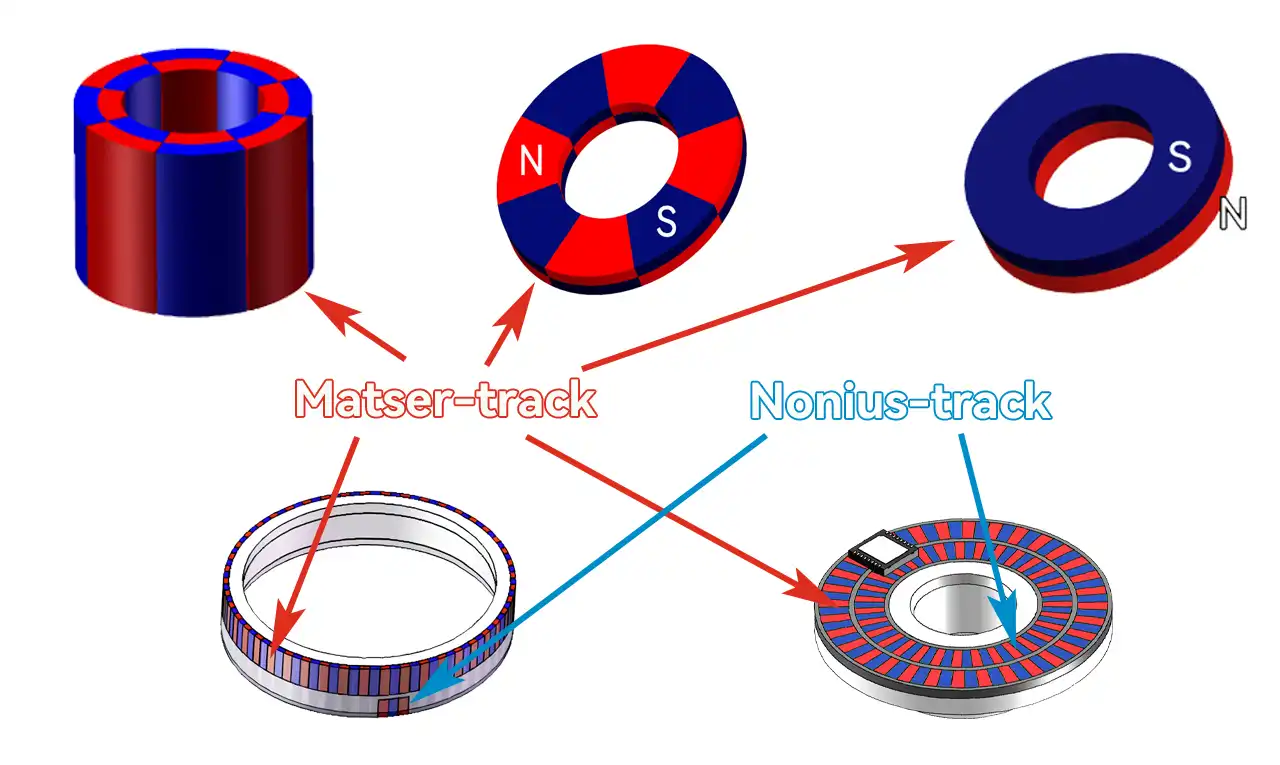
- La Piste principale (Master-track) fait référence au nombre de pôles de la piste magnétique principale sur un aimant annulaire. La plupart des aimants annulaires, comme ceux pour moteurs ou codeurs incrémentaux, n'ont qu'une seule piste magnétique.
- Cependant, les aimants annulaires pour codeurs absolus ou les aimants annulaires pour codeurs avec points de repère ont également une Piste Nonius (Nonius-track). Cela signifie qu'ils ont deux pistes magnétiques, comme indiqué sur l'image.
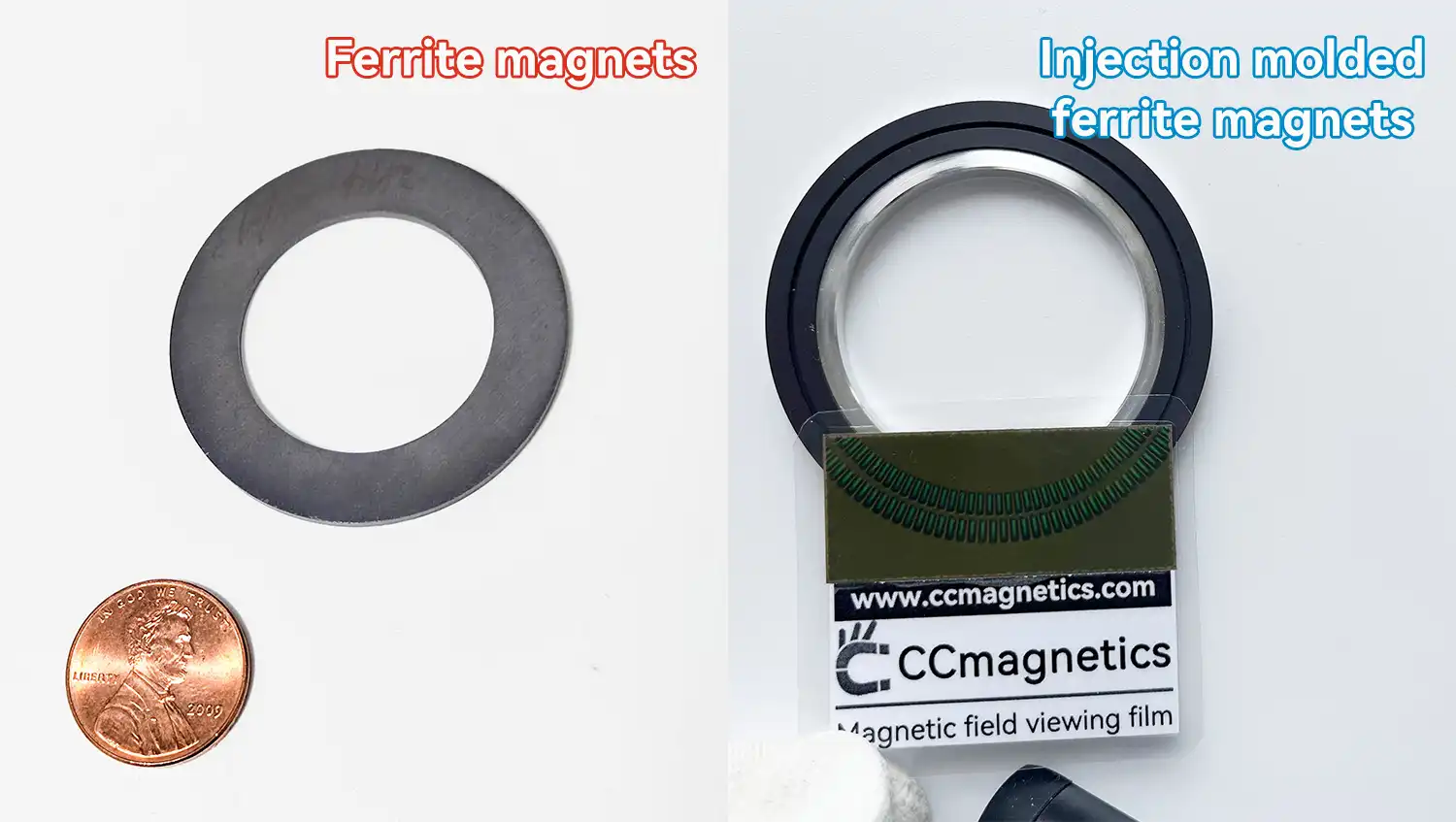
- Les aimants en ferrite sont également appelés ferrite frittée ou aimants en ferrite dure. Ils ressemblent et sont fabriqués comme de la céramique, c'est pourquoi certains les appellent aimants céramiques. Ces aimants sont peu coûteux à fabriquer en grandes quantités, même si les coûts des moules sont élevés. Ils sont très résistants à la rouille et aux hautes températures, jusqu'à 250℃. Les aimants en ferrite sont précis et économiques pour les codeurs. Mais, ils peuvent se casser facilement s'ils sont beaucoup secoués, comme dans les robots d'extérieur. Pour ceux-ci, le matériau magnétique en caoutchouc vulcanisé est plus stable.
- Les aimants en ferrite moulés par injection sont fabriqués en mélangeant de la poudre magnétique de ferrite avec des liants plastiques comme le Nylon (PA6 ou 12) ou le PPS. Ce mélange est ensuite moulé par injection, ce qui signifie qu'il est façonné à l'aide d'un moule. Ces aimants peuvent même être moulés directement sur un arbre métallique. Ils peuvent fonctionner à des températures allant jusqu'à 150°C.
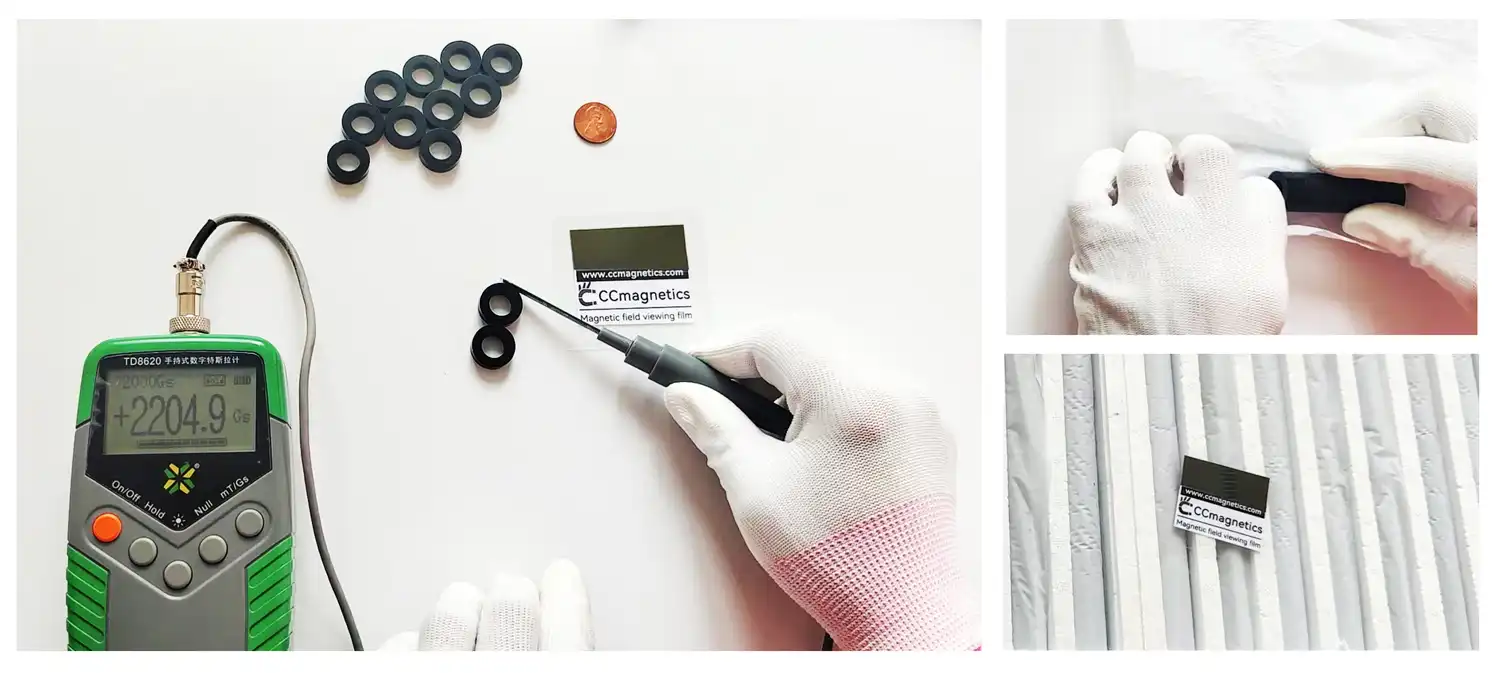
Les aimants en néodyme liés (collés) sont fabriqués en mélangeant de la poudre magnétique de néodyme avec un liant.
En termes simples, ils sont moulés par injection, ce qui signifie qu'ils contiennent un liant. Environ 80% de l'aimant est de la poudre de néodyme, et les 20% restants sont du liant.
Leurs avantages incluent une haute précision dimensionnelle, une grande flexibilité de conception et une bonne résistance mécanique.
Les aimants en néodyme moulés par injection sont fabriqués en mélangeant de la poudre magnétique de néodyme avec du thermoplastique. Ce mélange est ensuite moulé par injection. Ces aimants sont plus puissants que les aimants en ferrite moulés par injection.
Les aimants en néodyme moulés par injection peuvent être fabriqués dans de nombreuses formes. Ils peuvent être petits ou irréguliers. Vous pouvez les magnétiser avec plusieurs pôles ou des motifs complexes. Ils sont également très précis et constants dans leur forme.
Ces aimants peuvent être moulés directement sur des noyaux de moteur ou des arbres métalliques. Cela permet d'économiser des coûts d'assemblage. Ils sont considérés comme une option plus forte que les aimants en ferrite moulés par injection. Ils peuvent fonctionner à des températures allant jusqu'à 180℃.
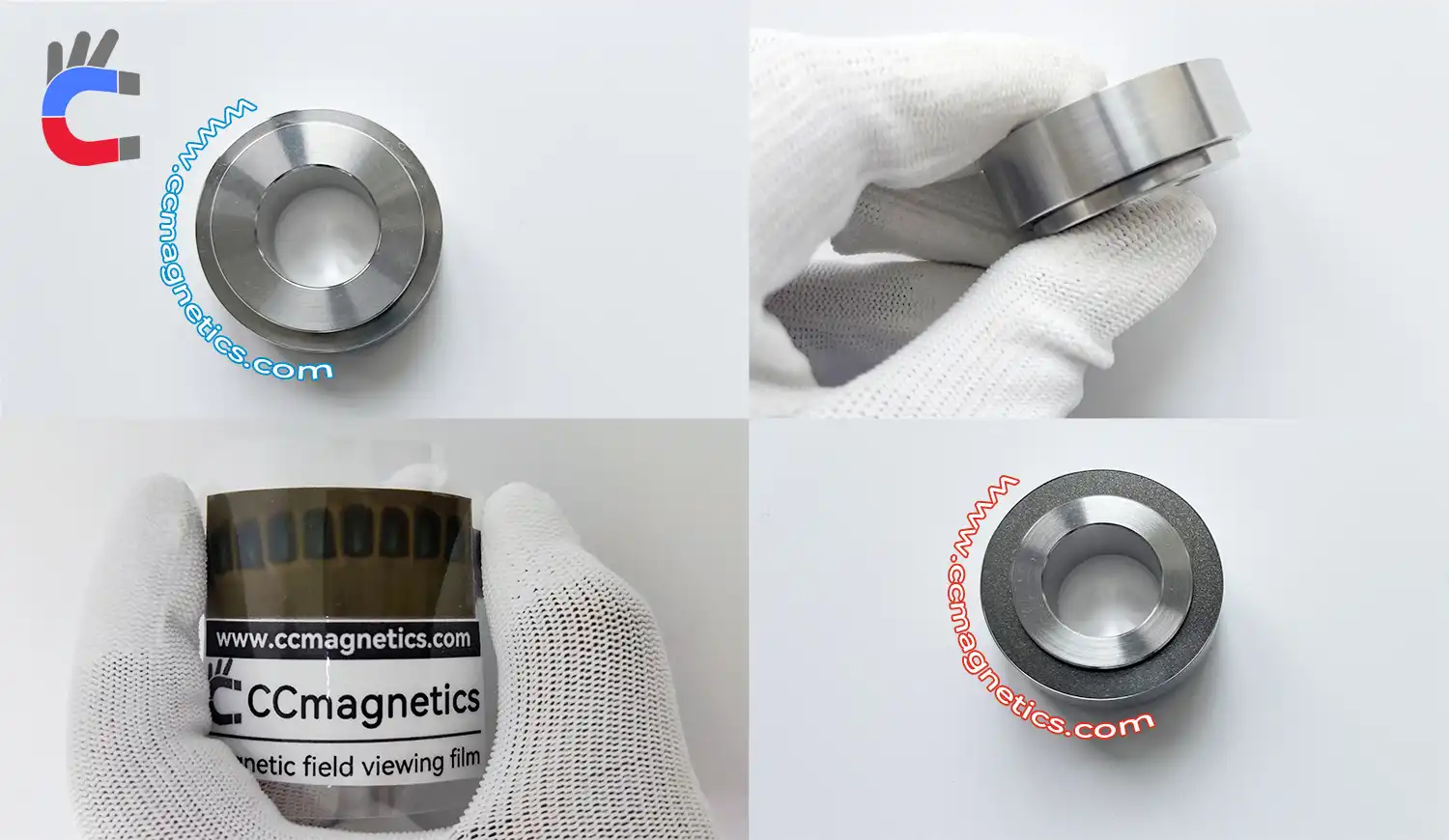
Ces aimants sont des aimants en néodyme ou ferrite moulés par injection qui incluent un support métallique. Veuillez voir l'image ci-dessous :
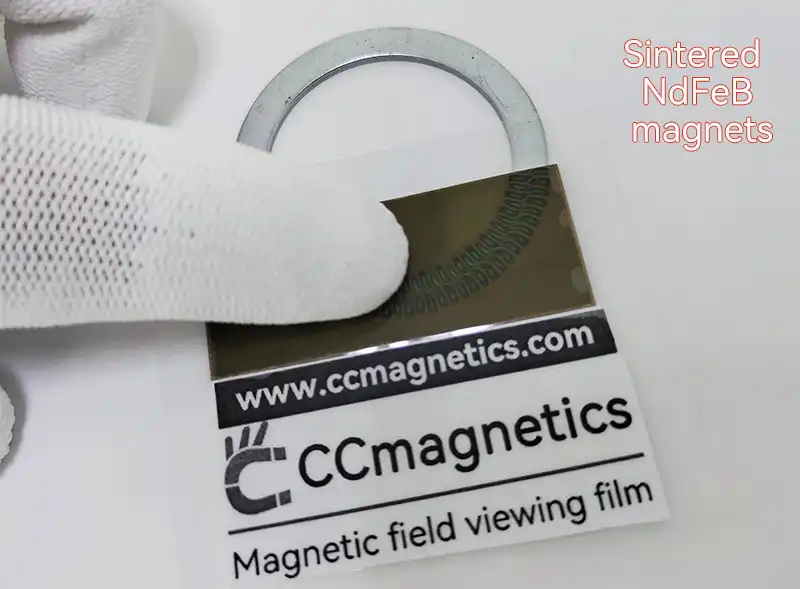
Les aimants NdFeB frittés sont également appelés aimants en Néodyme Frittés. Ce sont les aimants permanents les plus puissants connus. Ils sont fabriqués à partir de néodyme (Nd), fer (Fe), bore (B) et d'autres éléments de terres rares.
Ces aimants créent des champs magnétiques très puissants et restent magnétiques à température ambiante. Ils peuvent être fabriqués dans de nombreuses formes. Cela les rend parfaits pour de nombreuses utilisations, en particulier pour les moteurs commerciaux haut de gamme.
Le frittage est leur mode de fabrication. Les matériaux en poudre sont chauffés jusqu'à ce qu'ils fusionnent. Ce processus rend les aimants plus forts et plus efficaces.
Cependant, ces aimants peuvent se corroder facilement et sont affectés par les hautes températures. Ils sont donc généralement revêtus (souvent avec une couche nickel-cuivre-nickel) pour les protéger. L'ajout d'éléments de terres rares lourdes les aide également à résister à des températures plus élevées.
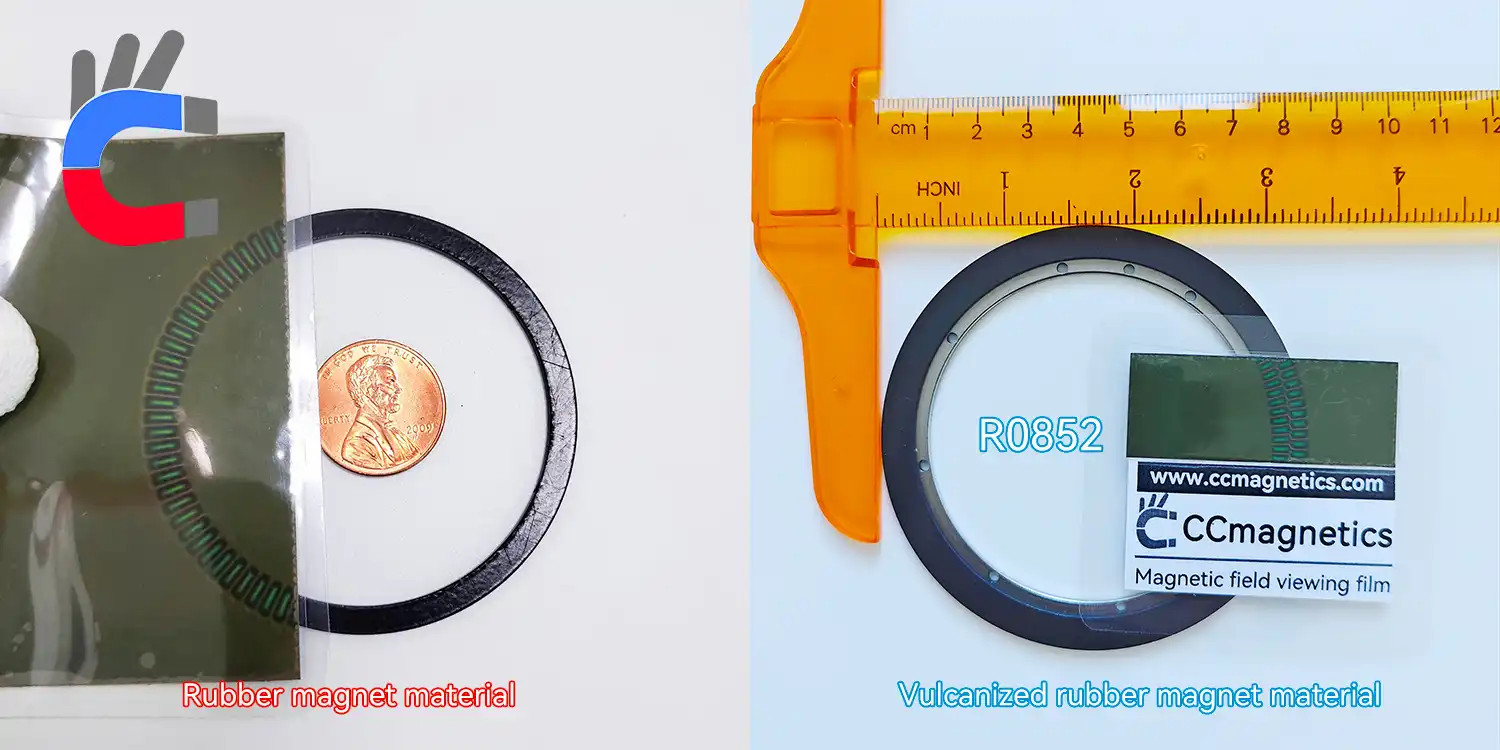
- Le matériau magnétique en caoutchouc vulcanisé est fabriqué lorsque de la poudre magnétique est ajoutée au caoutchouc au cours d'un processus appelé vulcanisation. Ce processus modifie la structure du caoutchouc, le rendant beaucoup plus fort, plus élastique et plus stable. Les aimants en caoutchouc vulcanisé sont souvent utilisés pour des cibles magnétiques sur des robots sportifs. Ils sont flexibles et ne se cassent pas facilement sous l'effet des chocs.
- Les aimants en caoutchouc sont fabriqués à partir de poudre magnétique mélangée à du caoutchouc synthétique. Ils sont formés par extrusion, calandrage ou moulage par injection. Vous pouvez les transformer en bandes, rouleaux, feuilles, blocs, anneaux et bien d'autres formes. Leurs principaux avantages sont qu'ils sont flexibles et peuvent être fabriqués en diverses formes. Cependant, leur inconvénient est qu'ils ne sont pas très puissants (ils n'ont pas une rémanence élevée) par rapport aux aimants en néodyme. Pour les codeurs, les aimants en caoutchouc ordinaires ne peuvent pas répondre aux besoins de haute précision. Ils ne sont bons que pour les codeurs incrémentaux à une seule piste.
English
Deutsch
Русский
Español
한국어
日本語


Avis
Il n’y a pas encore d’avis.